Pull a driver out of a van door after five winters of deliveries and look at the rubber ring. It has been living in diesel mist, hand grease off the door card, and whatever the cabin heater baked into it. On the wrong compound that surround is now tacky, swollen, and sitting a few millimetres off its designed profile. On nitrile it still looks like rubber. NBR (nitrile butadiene rubber) is the surround material for drivers that live around oil, grease or fuel vapour — it resists hydrocarbon swell far better than butyl, SBR or EPDM, at a compound cost that survives volume production.
Most engineers meet nitrile as an O-ring long before they meet it as a surround. That reputation is deserved — but the interesting part for acoustics is not that NBR resists oil. It is that you can dial how much.
The ACN knob: nitrile's one real superpower
NBR is a copolymer of acrylonitrile and butadiene, and the ratio is not fixed. Compounders shift the acrylonitrile (ACN) fraction across a broad window — roughly the high teens to about 50% — and that one number moves the material's whole personality:
- More ACN → better resistance to oils, fuels and hydrocarbon swell; higher hardness; better abrasion resistance; less gas permeability.
- Less ACN → better low-temperature flexibility; more compliance; softer feel; a lower glass transition temperature, so the surround stays alive on a cold morning.
The two ends pull against each other, and nothing wins both. Push ACN up to chase oil resistance and you raise the glass transition temperature — the point where rubber stops behaving like rubber and starts behaving like a stiff plastic ring glued to your cone. A high-ACN surround in a freezing garage is not a surround, it is a brake.
No other common surround material offers this. Butyl is butyl, EPDM is EPDM; you tune them with fillers and cure systems, but the backbone is what it is. With nitrile the backbone is a design variable, which is why the honest answer to "how cold-tolerant is NBR?" is another question: which nitrile?
Where nitrile earns its place on a driver
Three situations put NBR at the top of the list.
Oil or grease in the air. Car doors, commercial vehicles, kitchen and canteen ceiling speakers, workshop and factory-floor drivers, anything mounted near machinery that mists lubricant. Butyl and EPDM swell and soften in sustained hydrocarbon contact. Nitrile does not — that is the whole point of it.
Cost pressure with a durability floor. Volume drivers get specified SBR because it is cheap, then return as warranty claims because SBR gives up early on weathering and oil. NBR sits in the middle: tougher than SBR, cheaper than a premium halobutyl compound, easy to mould consistently. On a mid-tier automotive or commercial driver, that middle is often the right place to stand.
Handling abuse. Nitrile's abrasion and tear strength are genuinely good — useful on drivers installed, serviced and knocked about by hand in the field.
The two jobs to give someone else
Nitrile's butadiene backbone carries double bonds, and double bonds are what ozone and UV attack. Left in sunlight, an NBR surround crazes long before an EPDM one does. Antiozonants and protective waxes push that out considerably, and for an in-cabin or indoor driver it is a non-issue. For a patio speaker or a marine enclosure it is the wrong material — see surrounds for marine and outdoor speakers.
The second gap is acoustic. NBR damps, but not like butyl. If the goal is maximum suppression of cone-edge breakup and the cleanest rolloff at the top of a woofer's band, butyl is still the benchmark and nitrile is a compromise. Details in the butyl (IIR) guide.
| Requirement | NBR (nitrile) | Butyl (IIR) | EPDM |
|---|---|---|---|
| Oil, grease, fuel contact | Excellent | Poor | Poor |
| Internal damping | Moderate | Excellent | Moderate |
| Ozone / UV / outdoor | Fair — needs protection | Excellent | Excellent |
| Sealed-box air retention | Good (rises with ACN) | Excellent | Good |
| Cold flexibility | Depends on ACN | Good | Excellent |
| Abrasion / tear | Excellent | Moderate | Good |
| Compound cost | Low–moderate | Moderate | Moderate |
Undecided further upstream? Start at choosing a speaker surround material, or read butyl vs EPDM if oil is not in your environment at all.
Specifying nitrile, not just naming it
"NBR" on a drawing does not specify a surround. ACN fraction, Mooney viscosity, filler loading and cure system all move the finished part, and two rings both honestly labelled nitrile can land on different resonances. That gets solved before tooling, not after.
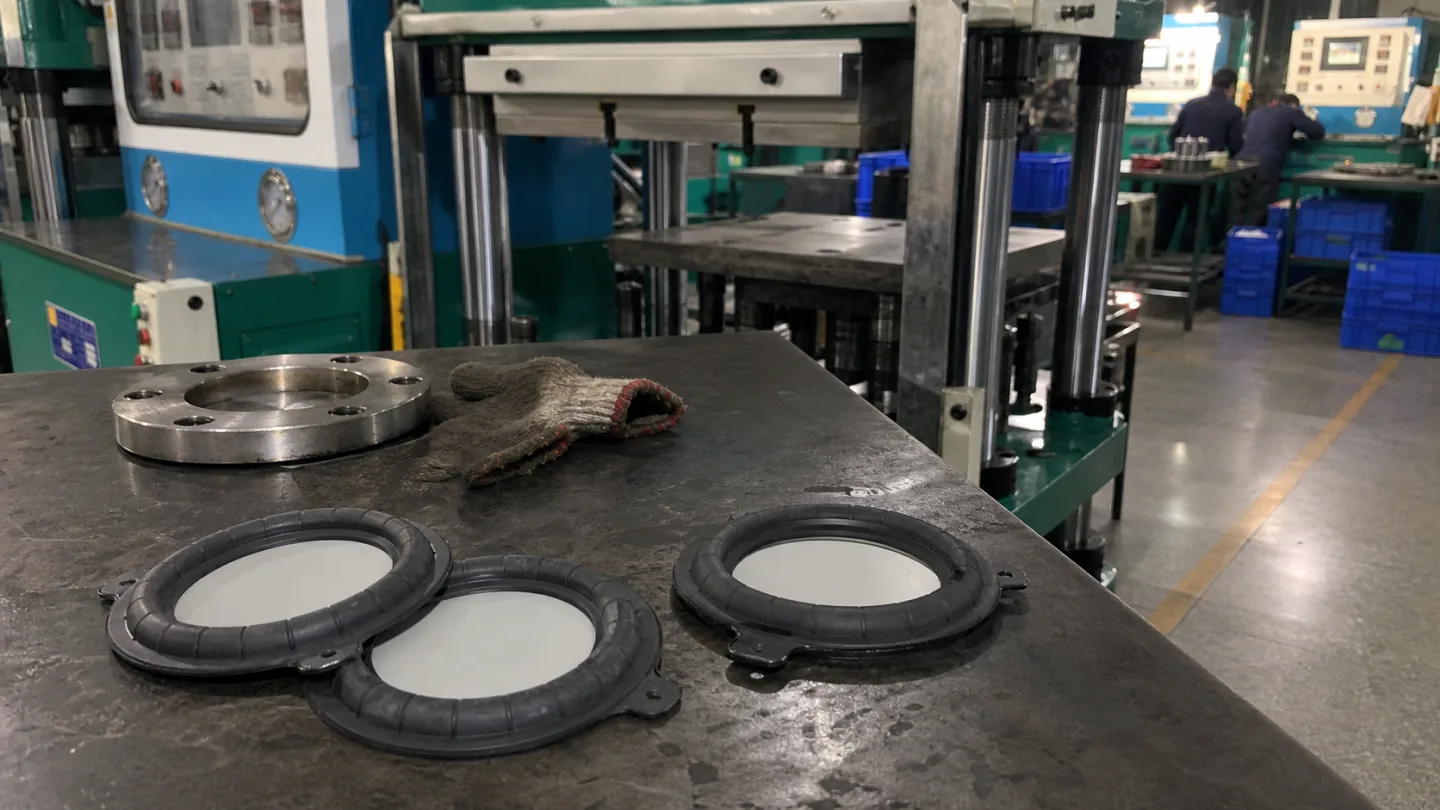
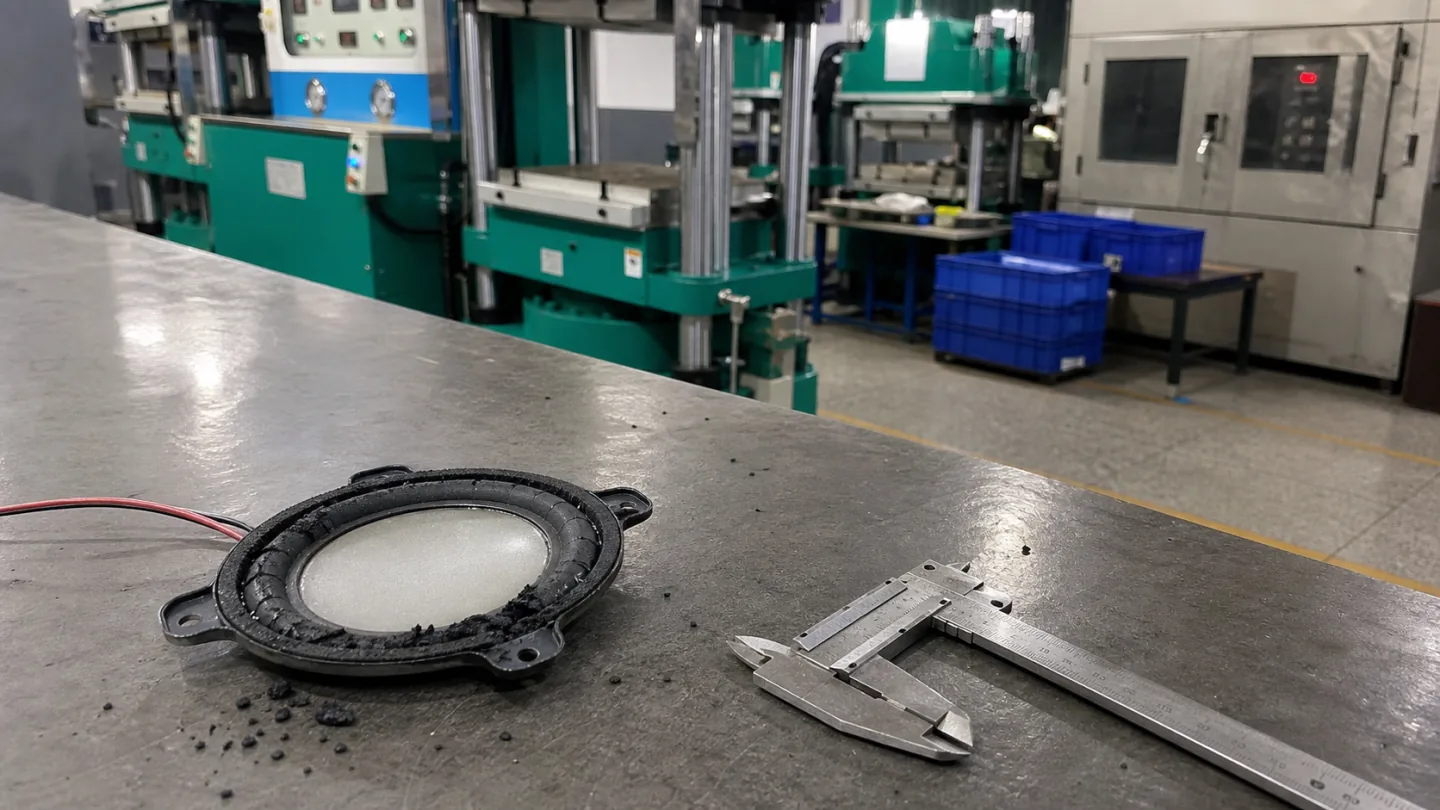
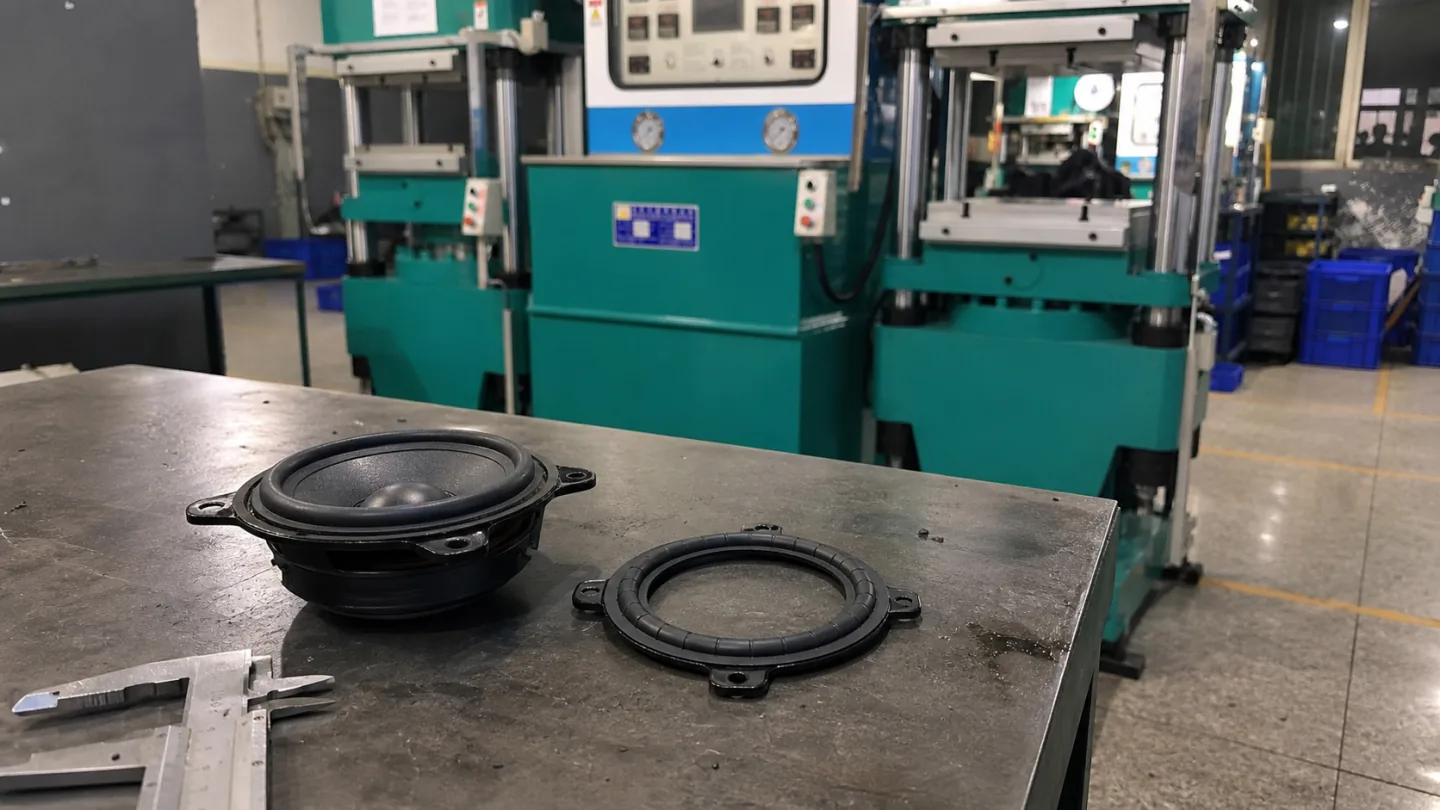
Compounding happens on our own floor — three mixing lines, so an ACN or filler change is a process step rather than a supplier negotiation, and 25 sets of hydraulic moulding presses take it to parts. Validation is where nitrile's tunability stops being theory: every batch goes on an F0 resonance-frequency tester, because the number that matters is whether unit 500 sits on the same resonance as unit 1. Roll geometry goes on a 2D optical measurement system — a profile 0.2 mm off design is a different spring, whatever the compound says. Shore A hardness, tensile, salt spray, UV ageing and constant temperature-humidity run across incoming, in-process and outgoing inspection.
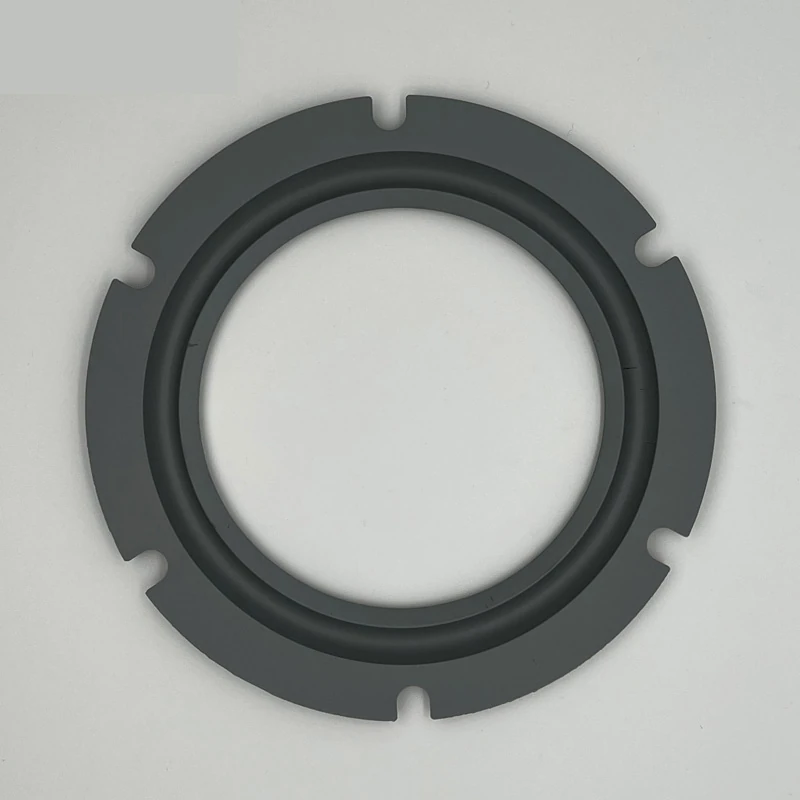
Stock NBR surrounds cover common 2"–4.5" driver sizes plus a general-purpose grade, with custom tooling out to 18". If oil is not your problem, butyl, EPDM and foam queue up behind it. Bring the environment and a target response; our OEM/ODM team works back to an ACN fraction and a roll profile.
FAQ
Why choose NBR over butyl for a speaker surround?
Oil. Butyl swells and softens in sustained contact with oils, greases and fuels; nitrile resists them. If a driver lives in a vehicle door, a workshop or a kitchen, NBR holds its geometry where butyl drifts. Butyl still wins on damping and outdoor ageing — pick by environment, not by ranking.
What does acrylonitrile content change in an NBR surround?
It trades oil resistance against cold flexibility. Higher ACN gives better resistance to oil, fuel and swell, plus more hardness and lower gas permeability — but a higher glass transition temperature, so the surround stiffens sooner in the cold. Lower ACN stays supple when cold and gives up some oil resistance. The right fraction follows the driver's real operating environment.
Can NBR surrounds be used outdoors?
Not as a first choice. Nitrile's backbone is vulnerable to ozone and UV, and sustained sun will craze it well before EPDM suffers. Protective additives extend life meaningfully, and covered or in-cabin use is fine. For genuine outdoor or marine service, specify EPDM.
Is NBR cheaper than butyl or EPDM?
Generally yes at compound level, and it moulds easily at volume — much of why it appears on cost-sensitive automotive and commercial drivers. It is not the cheapest option; SBR is. NBR buys real oil, abrasion and tear resistance for that small step up.