A materials consultant sent a small speaker brand our way last year with a spec sheet that named IR — synthetic isoprene rubber — for the surround on an 8" woofer. The reasoning was not stupid. The consultant had come from medical devices, where IR is genuinely excellent, and carried the habit across. Consistent batches, no latex proteins, natural-rubber elasticity. All true. All beside the point for a ring that has to survive twenty years on the edge of a cone.
The conversation was worth having, because the reason IR fails here is the reason it succeeds elsewhere.
What IR actually is, and where it earns its price
Natural rubber is cis-1,4-polyisoprene, biosynthesised inside a tree. IR is cis-1,4-polyisoprene, polymerised in a reactor from petroleum-derived monomer. Same repeating unit, same architecture, same strain-crystallising behaviour.
The difference is not the molecule. It is everything travelling with it. Natural rubber arrives carrying roughly one to two percent of things that are not rubber: proteins, phospholipids, fatty acids, gel, minerals picked up from soil — passengers that vary with the plantation, the season, the tapping. IR has none of them. What leaves the reactor is polyisoprene and a known trace of process residue.
That purity is the whole product:
- No latex proteins. The Type I allergy risk that makes natural latex unusable for sensitised people does not exist in IR — which is why IR gloves are a real category for surgeons needing latex-grade feel without the allergen.
- Batch-to-batch sameness. A reactor with a defined catalyst repeats itself in a way agriculture cannot. Automated lines that cannot stop to re-tune for a new bale care about this.
- Clean, predictable extractables. No fatty acids to migrate and yellow a white part, no biological fingerprint shifting by lot. Adhesives — medical tape, transdermal patches — lean on this hard.
IR is the right call in those places. Trouble starts when the reasoning gets exported to acoustics.
Why the surround rejects it
Look at the backbone. Polyisoprene carries a double bond in every repeat unit, and a double bond is an open invitation to ozone. On a part held under cyclic strain — which is exactly what a surround is, millions of flexes over its life — that attack concentrates into cracks walking inward from the surface.
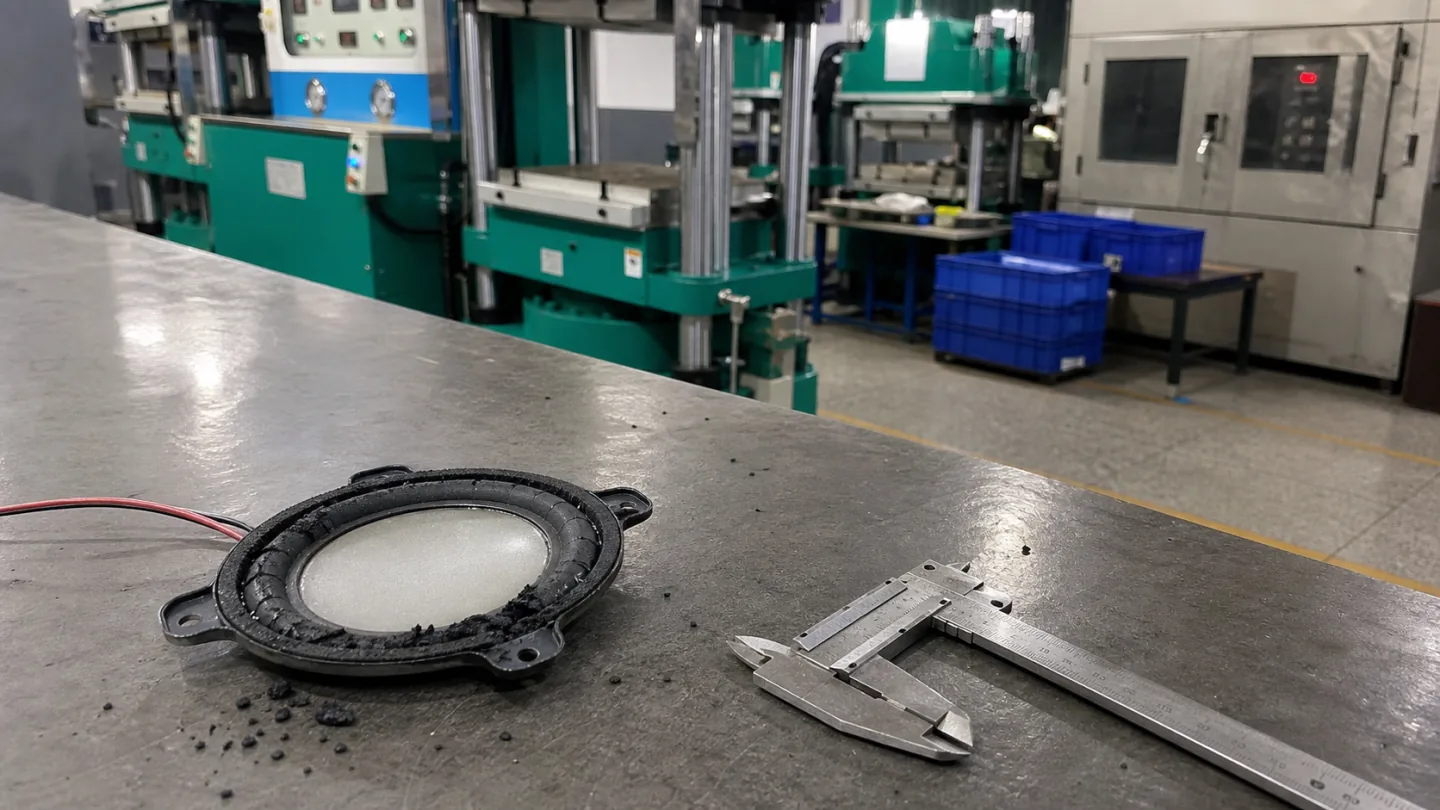
IR inherits this completely. Same chemistry, same weakness. Indoor ozone is low but not zero, and a surround gets no rest: strained rubber cracks faster than the same rubber sitting still. Add window UV and the clock speeds up again. The failure is not dramatic. It goes matte, then fine perpendicular cracks appear along the roll, then the roll splits and the cone starts rubbing. Years, not decades. Butyl's backbone carries almost no double bonds — nothing for ozone to grab. That is the difference between a scheduled failure and no failure.
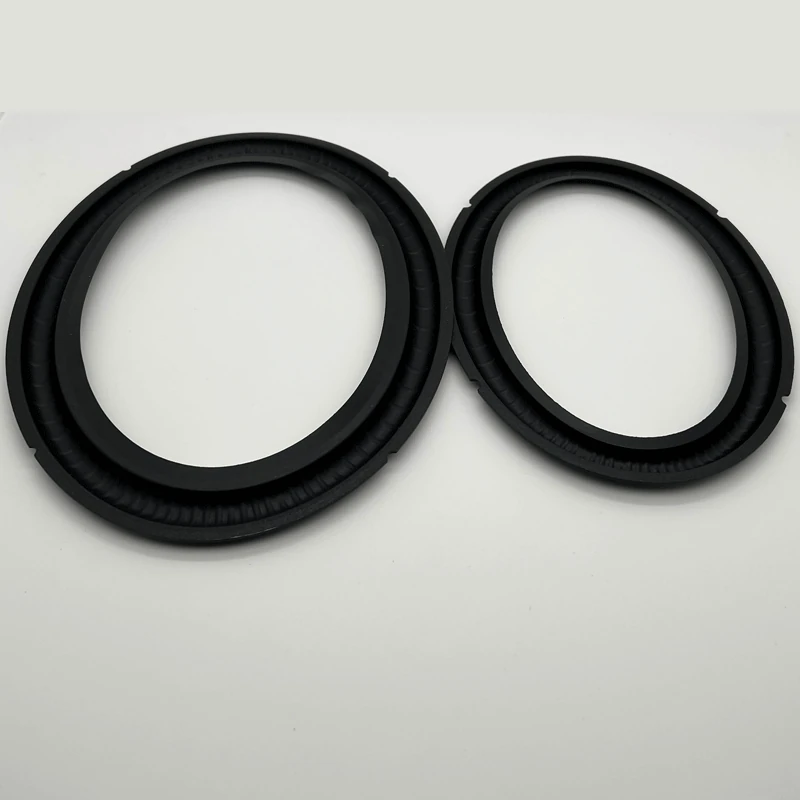
The second problem is damping. A surround is not just a hinge, it is a resonance sink: it swallows the energy arriving at the cone edge instead of reflecting it back. Polyisoprene is springy — it returns energy rather than converting it to heat. Good for a rubber band, wrong for this. IR damps noticeably less than butyl, so edge resonances survive to reach your ears. Choosing a speaker surround material points the same direction.
IR vs butyl vs EPDM, judged only as a surround
| In a surround | IR (synthetic isoprene) | IIR (butyl) | EPDM |
|---|---|---|---|
| Ozone / weather resistance | Poor — unsaturated backbone | Excellent | Excellent |
| Internal damping | Low — resilient, springy | Excellent, the benchmark | Moderate |
| Air retention (sealed box) | Moderate | Excellent | Good |
| Realistic service life indoors | Years | Decades | Decades |
| Elasticity / stretch | Excellent | Good | Good |
| Why anyone specifies it | Purity, no proteins, batch consistency | Damping + sealing + ageing | Outdoor and marine duty |
IR wins one row a surround never asks about, and loses the three it does.
So what does your driver want?
For almost every enclosed driver, butyl (IIR) is the default and deserves to be: high damping, very low gas permeability, an ageing profile that outlives the coil. Outdoors, on a patio, in a marine cabinet or a car door that bakes, EPDM takes over — see butyl vs EPDM surrounds. Oil or fuel contact pushes you to NBR. Chasing efficiency and minimum moving mass, lifespan trade understood, means foam — laid out in rubber vs foam surrounds.
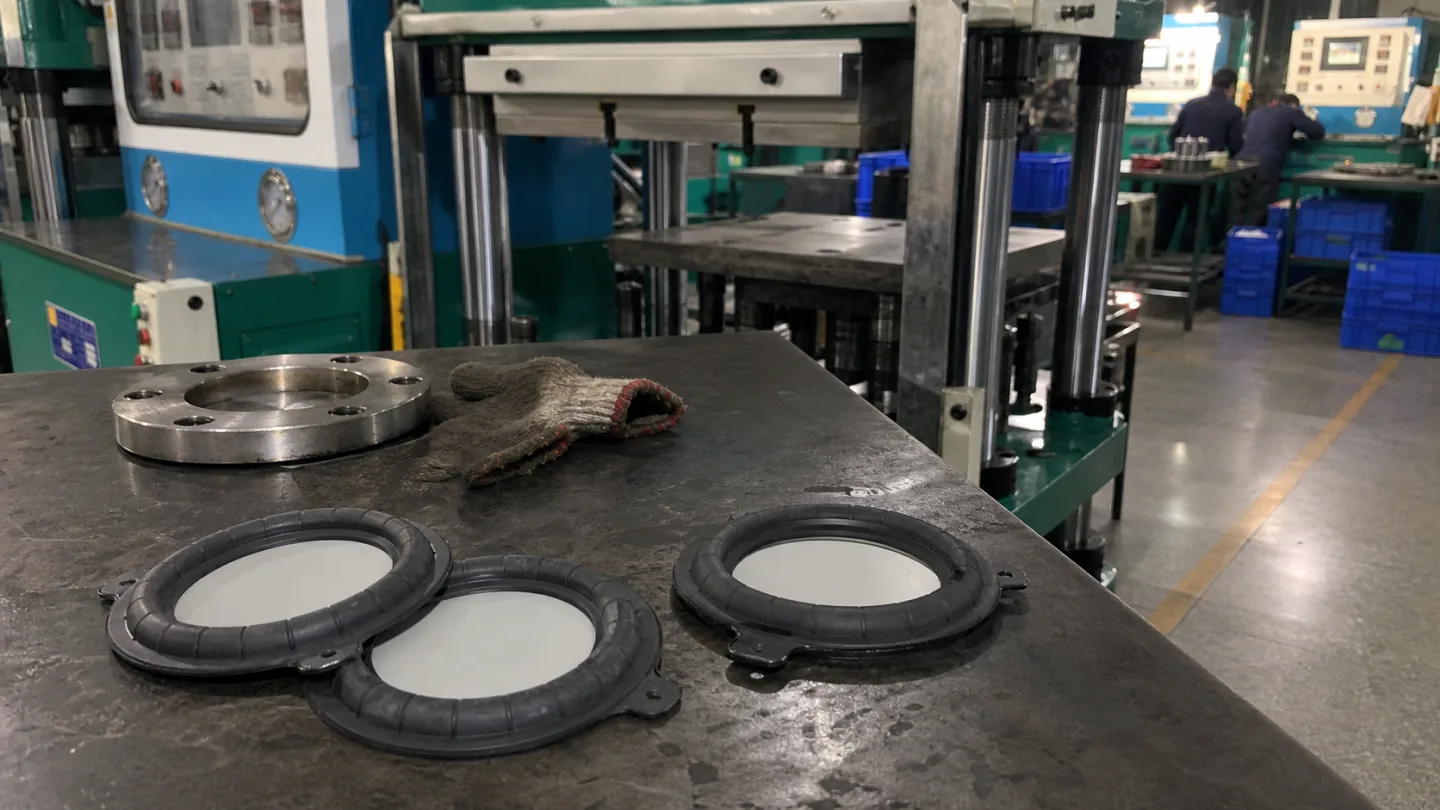
We do not compound IR and will not quote it for a surround — the same answer you would get for natural rubber. What we do is prove the materials we do build actually hold. UV ageing and constant temperature-humidity chambers run on those compounds, so ageing claims come from a cabinet rather than a datasheet. Every batch crosses an F0 resonance-frequency tester, because damping that drifts between unit 1 and unit 500 is not damping you can design around, and roll geometry goes on a 2D optical measurement system — 0.2 mm off profile is a different spring. Incoming, in-process and outgoing inspection, all three. Bring a target response to our OEM/ODM team and the compound gets chosen for the driver, not for a habit imported from another industry.
FAQ
Is IR the same thing as natural rubber?
Chemically, near enough — both are cis-1,4-polyisoprene. The difference is what rides along: natural rubber carries proteins, fatty acids and gel that vary by batch, IR carries none of them. That makes IR cleaner and more repeatable, and leaves the backbone's weaknesses — ozone, UV, oil — intact in both.
Could an IR surround ever be the right choice?
Only where the ozone clock does not matter and skin contact does — a short-life product, or a prototype. For a driver expected to work in ten years, no: it offers a surround nothing it needs and removes the ageing resistance it depends on.
Is IR stronger than natural rubber?
Not in the raw state. Uncured green strength is where natural rubber's very long chains earn their keep — natural rubber sits around 1–2 MPa green, and IR lands below that, which is why IR compounds are harder to handle before cure. Vulcanised properties are a separate matter entirely and should never be compared to green figures; cured, the two are close, with natural rubber usually a little ahead on gum tensile.
What about IR in medical rubber parts?
That is where it belongs — gloves for latex-allergic clinicians, pressure-sensitive medical adhesives, light-coloured parts that must not yellow. Injection-vial stoppers, worth noting, are a halobutyl story rather than an IR one; the gas barrier requirement there decides it. IR is a strong material with a real job. That job is not on the edge of a cone.