A bookshelf woofer and a tower speaker bolted to a boat's arch are fighting two different wars, and the surround is where the outcome gets decided. The bookshelf driver needs the rubber to disappear — no extra ring, no coloration bleeding in from the cone's edge. The boat driver needs the rubber to survive months of UV, salt spray and temperature swings without going stiff and letting go of the cone. Butyl and EPDM are the two compounds built for exactly those two jobs, and mixing them up shows up later as either a boomy, uncontrolled woofer or a surround that splits a season after install.
Both are premium rubbers, not filler-grade fallbacks, which is part of why getting the pick right before you commit to tooling actually matters.
Butyl (IIR) vs EPDM at a glance
| Factor | Butyl (IIR) | EPDM |
|---|---|---|
| Internal damping | High — quiets cone-edge resonance | Moderate |
| Air leakage | Low — tight, sealed enclosure behavior | Slightly higher than butyl |
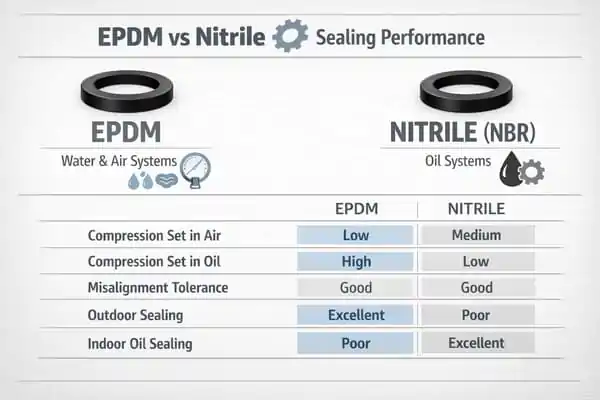
| Weather / ozone / UV | Good | Excellent — the compound's whole reason to exist |
| Best environment | Indoor / controlled, premium hi-fi | Outdoor, marine, powersports |
| Sound signature | Clean, controlled, low-distortion bass | Slightly more open, still controlled |
| Typical use | Premium woofers, studio and home monitors | Marine towers, powersports, outdoor PA |
Sound: why butyl damps the way it does
A surround isn't just a hinge for the cone — it's also where unwanted energy at the cone's edge either gets absorbed or bounces back and colors the sound. Butyl's high internal damping absorbs that energy efficiently, which is why it's the default pick for premium woofers where a customer expects tight, low-distortion bass rather than a boomy one-note thump. It also has naturally low air permeability, so a sealed or ported box built around it holds its intended acoustic loading instead of slowly leaking through the surround itself over years of use. EPDM isn't a poor performer here — it's a perfectly usable, slightly more open-sounding compound — it's just not tuned for the same job. Nobody is choosing EPDM because they want the last word in damping; they're choosing it because the driver has to survive somewhere butyl wouldn't.
Environment: where EPDM earns its keep
This is the category EPDM was made for. Marine tower speakers, powersports audio bolted to a roll cage, outdoor PA left under a permanent sun — all of it needs a compound that shrugs off UV, ozone and humidity cycling without turning brittle or losing its grip on the cone. That's not a marketing claim on our end; it's what our salt-spray chamber, UV-aging chamber and constant temperature-and-humidity testing are there to confirm before a compound goes into a customer's spec sheet. Butyl holds up reasonably well indoors and in normal home use, but it isn't the compound you reach for when a driver lives outside permanently. If the application involves direct weather exposure, EPDM is the correct default, not a downgrade.
Cost and how a run actually moves
Neither compound is exotic to tool or run — the cost difference between butyl and EPDM at the same durometer and profile is modest, and the bigger cost lever is usually the mold itself, not the raw material. What's consistent across both: a first sample turns around in 3–7 days, and once that sample is approved and a deposit is placed, mass production runs 15–30 days. Catalog-size surrounds carry an MOQ around 500 units per SKU; a 100-unit trial order is workable if you want to validate a batch before committing to the full run, and a fully custom mold — for either compound — sits at a higher minimum. Every batch, regardless of compound, moves through incoming, in-process and outgoing inspection, with Shore A hardness and tensile pulled at each stage and F0 resonance testing used to confirm the finished surround still matches the driver's intended tuning, not just its size.
How to choose for your line
- Premium home or studio woofer, controlled bass matters: butyl (IIR)
- Marine, powersports, or permanent outdoor install: EPDM
- Sealed enclosure where air leakage would shift the tuning: butyl
- Product spends its life in direct sun or salt air: EPDM
- Need a flame-retardant or custom-color variant of either: both compounds can be formulated that way — flag it at the sampling stage
We run both compounds across the same 2"–18" size range, so switching a design from butyl to EPDM (or the reverse) partway through development doesn't mean starting the mold from scratch in most cases. If you're still working out which compound and Shore A hardness fit a specific driver, our custom OEM/ODM service will match the spec to the application, and the full range is on our products page. For the broader question of rubber versus foam before you even get to compound choice, see our guide to choosing a surround material.
FAQ
Is EPDM a downgrade from butyl?
No — they're both premium rubbers built for different jobs. Butyl damps better for clean indoor bass; EPDM resists weather better for outdoor and marine use. Neither is simply superior to the other.
Can butyl surrounds be used outdoors at all?
They hold up reasonably well in normal home and light outdoor use, but for permanent sun, salt spray or ozone exposure, EPDM is the safer long-term choice — that's exactly the environment it's formulated for.
Does switching from butyl to EPDM change the sound much?
It can shift the tone slightly toward a more open character, since butyl's higher damping is what tightens up the bass. For most designs the difference is a tuning consideration, not a dealbreaker — worth confirming with F0 testing on a sample.
Do you offer both compounds in custom sizes?
Yes, both butyl and EPDM run across our full 2"–18" size range, including custom molds, flame-retardant or custom-color variants, and Shore A hardness tuned to the driver.