A driver engineer emailed us a chemical resistance chart pulled off a materials database, one row highlighted in yellow: polysulfide, lowest gas permeability in the table, better than butyl. His car-door woofers were losing sealed-box tuning over three summers, and here was a rubber that appeared to leak even less than the one everyone uses. Why was nobody making surrounds out of it?
Because polysulfide is not a moulding rubber. It is a sealant. It arrives as a two-part paste, cures in the joint it was squeezed into, and has mechanical properties that would embarrass any surround on a test bench. The permeability number in that chart is real. Everything a surround also needs, T fails.
What polysulfide is genuinely the best at
Give the material credit before taking it away. Polysulfide's backbone carries sulfur atoms in the main chain rather than the carbon–carbon double bonds that ozone and UV chew through. That saturated backbone buys two things almost nothing else offers together: it shrugs off hydrocarbons, and it barely lets gas through.
The applications follow from that pair. Commercial aircraft integral fuel tanks — the wing box itself is the tank — are sealed with polysulfide along every rivet line, sitting in Jet-A through decades of pressurisation cycles. Insulated glazing units use it as the secondary seal, holding the argon fill in and moisture out for the twenty-year life of the window. Building expansion joints get it for the same reason: it moves with the joint and shrugs off weather.
Notice what those have in common. The material is applied as a liquid into a gap, cures in place, and never moves as a structural part. It bonds two things that would otherwise leak. That is a glue, chemically and functionally — the name Thiokol comes from the Greek for sulfur and gum, which is an honest description. Joseph Patrick and Nathan Mnookin discovered the chemistry independently in the 1920s and founded Thiokol Corporation to sell it — a sealant business ever since.
Why none of that transfers to a surround
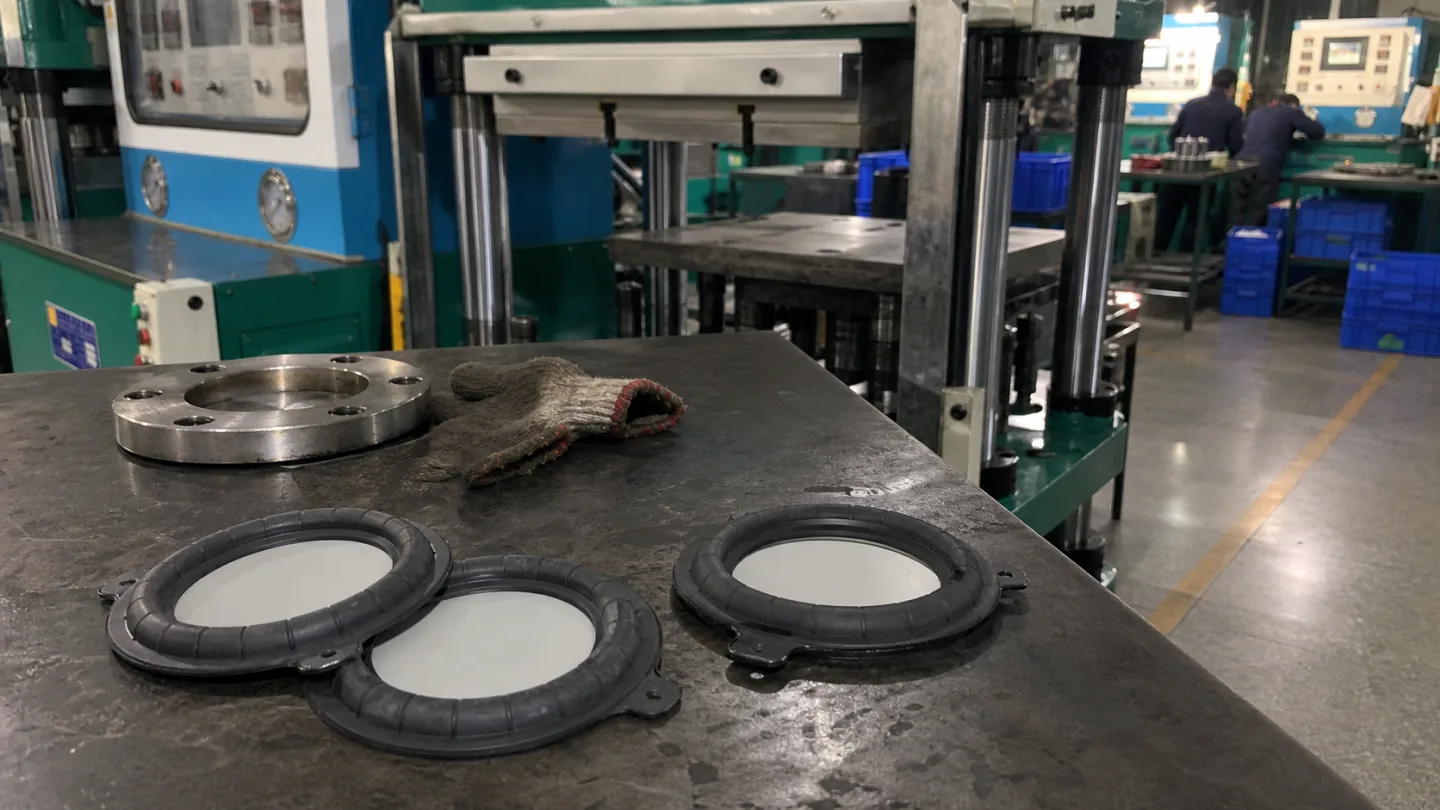
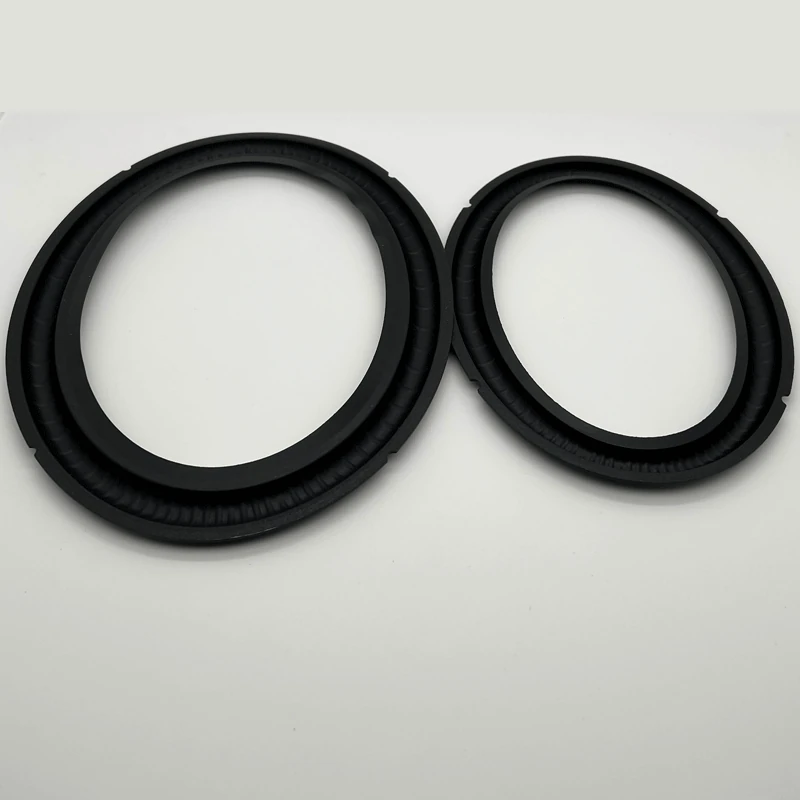
A speaker surround is a thin, precisely shaped moulded part. It has to be pressed to a roll profile within tenths of a millimetre, survive millions of flex cycles at that exact geometry, and be clean enough to sit inside a consumer product. Polysulfide loses on every line of that job description.
It is a liquid system, not a compound you mill and vulcanise. Solid high-molecular-weight grades exist, but they are a commercial footnote — barely stocked, and nobody runs thin-wall speaker tooling in them. Mechanical strength is low: tensile and tear sit well under any general-purpose surround compound — fine when the material is buried in a wing joint under compression, disqualifying when it is the only thing holding a cone to a basket. And it smells. Mercaptan chemistry means a thiol odour that never fully leaves the part. Acceptable in a fuel tank. Not in a bookshelf speaker in someone's living room.
That leaves the property that started the question — low permeability. Here the argument collapses on its own terms, because butyl already delivers that, and delivers everything else too. IIR moulds beautifully into thin rolls, has the highest internal damping of the common surround rubbers, and has no smell. The chart was answering a question butyl had already closed.
The three materials, judged on the surround job
| Requirement | Polysulfide (T) | Butyl (IIR) | EPDM |
|---|---|---|---|
| Forming method | Two-part paste, cures in joint | Compression moulded | Compression moulded |
| Thin-wall moulded parts | Effectively never done | Standard practice | Standard practice |
| Tensile / tear strength | Low | Adequate for surrounds | Good |
| Gas permeability | Very low | Very low | Moderate |
| Internal damping | Not characterised for acoustics | Excellent — the benchmark | Moderate |
| Odour | Thiol / sulfur, persistent | None | None |
| Fuel and solvent contact | Best in class | Poor | Poor |
| Outdoor / UV / ozone life | Excellent | Excellent | Excellent |
Read the table as a shape, not a scoreboard. Polysulfide wins two rows — the two rows a speaker never asks about.
So what should your driver use
Work backwards from the failure you are trying to prevent.
- Sealed box losing alignment over years. A permeability problem, and the answer is butyl (IIR) — same barrier property, in a material that moulds.
- Cone-edge resonance, muddy bass at excursion. Butyl again; high internal damping is why it dominates. Background in choosing a surround material.
- Permanent outdoor, marine or car-door exposure. The live decision is EPDM versus butyl: butyl vs EPDM surrounds.
- Oil, fuel or solvent splash. The one place the polysulfide instinct points at something real — but for a moulded acoustic part the answer is NBR, not T.
- Maximum efficiency, minimum moving mass. Foam, accepting the shorter service life.
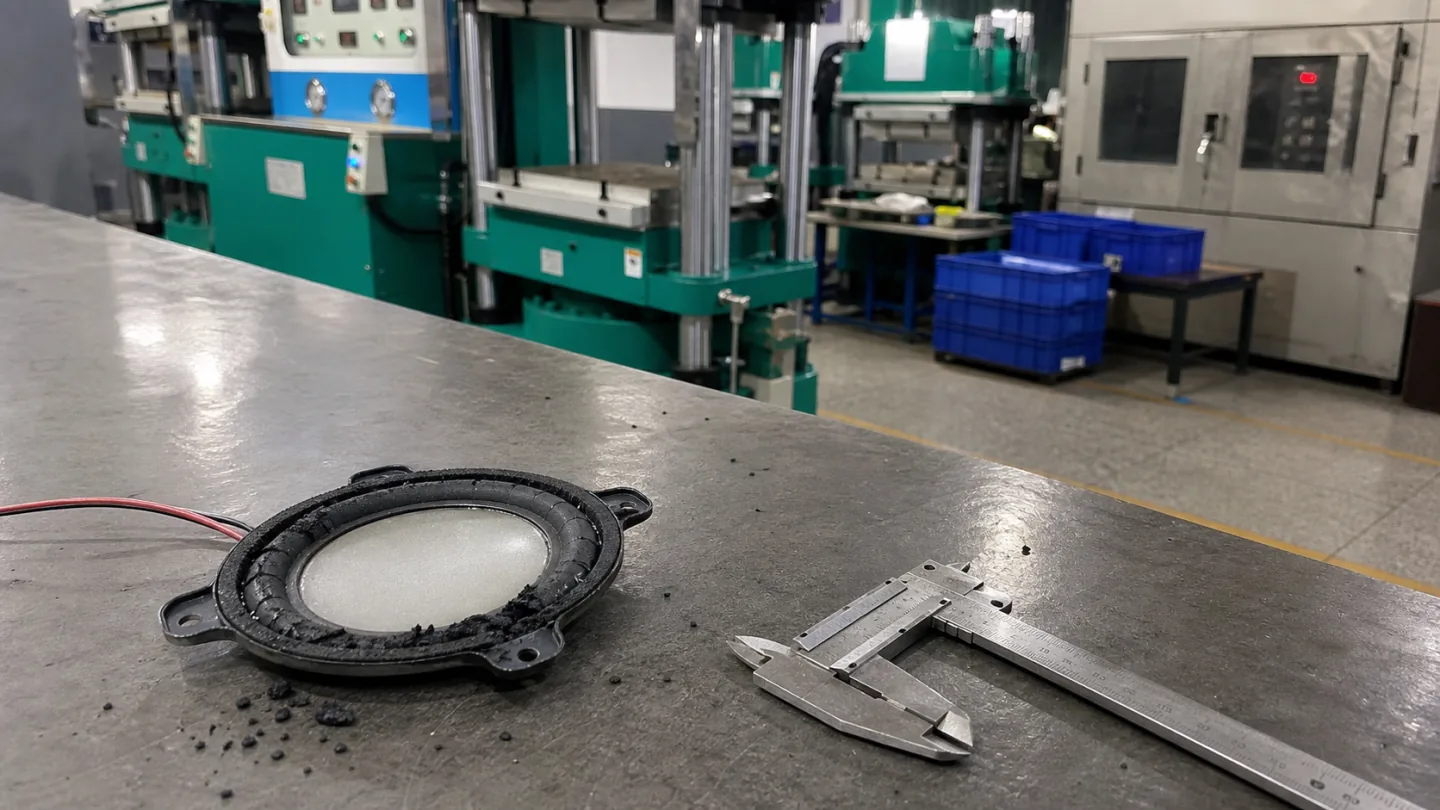
We do not compound polysulfide and never will — nothing in a loudspeaker asks for it. What we run is rubber mixed in-house and validated for what matters here: every surround batch crosses an F0 resonance-frequency tester, so unit 500 sits on the same resonance as unit 1, and roll geometry goes on a 2D optical measurement system, because a profile 0.2 mm off design is a different spring. Incoming, in-process and outgoing inspection on every run. Trying to close a leak or kill a resonance in a real driver? Bring it to our OEM/ODM team and we work back from the measurement to a compound.
FAQ
Can polysulfide rubber be used for a speaker surround?
In practice, no. It is a two-part sealant that cures in place rather than a compound you mould into thin rolls, its tensile and tear strength are low, and it carries a persistent thiol odour. Conventionally processable solid grades are a rarity, and no surround tooling runs in them.
Polysulfide has lower gas permeability than butyl — doesn't that matter for a sealed box?
Both sit at the low end of the scale, far below general-purpose rubbers. Once the leak rate is that low, permeability stops deciding anything and moulding, damping, strength and odour take over — butyl wins all four. Choosing T for a marginal barrier gain costs you the entire rest of the part.
Where should I actually specify polysulfide?
Static joints that must hold fuel, solvent or gas for decades: aircraft integral fuel tanks, insulated glazing secondary seals, building expansion joints, concrete tank penetrations. Not dynamic parts, not moulded components, and nothing above roughly 120°C.
What is the closest surround material to polysulfide's strengths?
Split it in two. For the gas barrier, butyl (IIR). For hydrocarbon contact, NBR. No single mouldable surround rubber matches both at once, and almost no loudspeaker needs both.