Pull the grille off a woofer built in the last thirty years and look at the ring joining the cone to the basket. Odds are it is black, slightly matte, and feels dead when you flick it — no ring, no bounce, just a dull tap. That is butyl, and that dead feel is not a side effect. It is the reason the material is there. IIR (butyl) rubber dominates speaker surrounds because it combines unusually high internal damping, near-zero gas permeability and long-term resistance to ozone, UV and humidity — the exact three things a surround has to do at once.
Butyl earned its reputation elsewhere first — inner tubes, bottle closures — but the property that makes it hold air in a tyre is only half of why it ended up on the edge of your cone.
Damping: the property that actually sells butyl to acoustics
A cone is not a rigid piston. Push it hard enough and the outer edge starts doing its own thing — breakup modes, standing waves running around the rim, energy that arrives at your ear as smear rather than music. The surround sits where those waves terminate, and its job is to swallow them rather than reflect them back into the cone.
Butyl is unusually good at this. Its molecular structure converts mechanical energy into heat rather than storing and returning it — that is what "high internal damping" means, and why a butyl offcut dropped on a bench thuds instead of bouncing. On a driver it shows up as a smoother rolloff at the top of the woofer's band, fewer peaks where edge resonances used to live, and cleaner bass at high excursion.
Damping is a trade, not a free win. The same loss mechanism that eats resonance eats a little sensitivity, and butyl is heavier than foam, which lowers efficiency and shifts the driver's resonance. A deliberate exchange: control and low distortion, paid for in a decibel or two. Full comparison in rubber vs foam surrounds.
Permeability: the sealed box stays sealed
A sealed enclosure works because the trapped air behind the cone acts as a spring. Leak that air and the spring softens, the alignment drifts, and the tuning measured in the lab is not the tuning the customer hears in year three.
Butyl's gas permeability is far lower than most general-purpose rubbers — the same property that made it the standard for inner tubes. On a speaker it means the surround is not a slow leak: the box holds its alignment, and a well-built sealed woofer measures close to spec long after purchase. Foam cannot make that claim, and neither can most cheaper compounds.
Ageing: why butyl surrounds outlive the speakers
Butyl's backbone carries very few double bonds — chemistry's way of saying there is almost nothing for ozone and UV to attack. That is the difference between a butyl surround and the foam ring that turned to grey crumbs on your 90s bookshelf speakers. Foam rot is a scheduled event. Butyl does not have one; surrounds routinely outlast the cone, the coil and the owner's interest in the speaker.
It is also more cold-tolerant than most people assume, staying flexible well below freezing — a driver in a cold garage or an unheated car door still moves as designed on a January morning.
Where butyl is the wrong call
| Requirement | Butyl (IIR) | Better option |
|---|---|---|
| Damping, low distortion | Excellent — the benchmark | — |
| Sealed-box air retention | Excellent | — |
| Ozone / UV / humidity | Excellent | EPDM comparable |
| Continuous outdoor / marine exposure | Good | EPDM |
| Oil and fuel contact | Poor | NBR |
| Maximum efficiency, minimum mass | Heavier | Foam |
| Lowest unit cost | Moderate | SBR, foam |
The live decision on most projects is butyl or EPDM — how much of the driver's life is spent in weather, versus how much distortion the design can afford. That one is worth its own read: butyl vs EPDM surrounds. Still upstream of the compound choice? Start with choosing a speaker surround material.
Butyl is a family, not a recipe
"Butyl" names a class. Regular butyl and the halogenated versions (chlorobutyl, bromobutyl) that cure faster and bond better all behave differently on the mould and in the box, and damping, hardness and rebound move again with filler loading and cure system. Two surrounds both honestly labelled butyl can produce measurably different drivers — the compound recipe, not the material name, is the specification that matters.
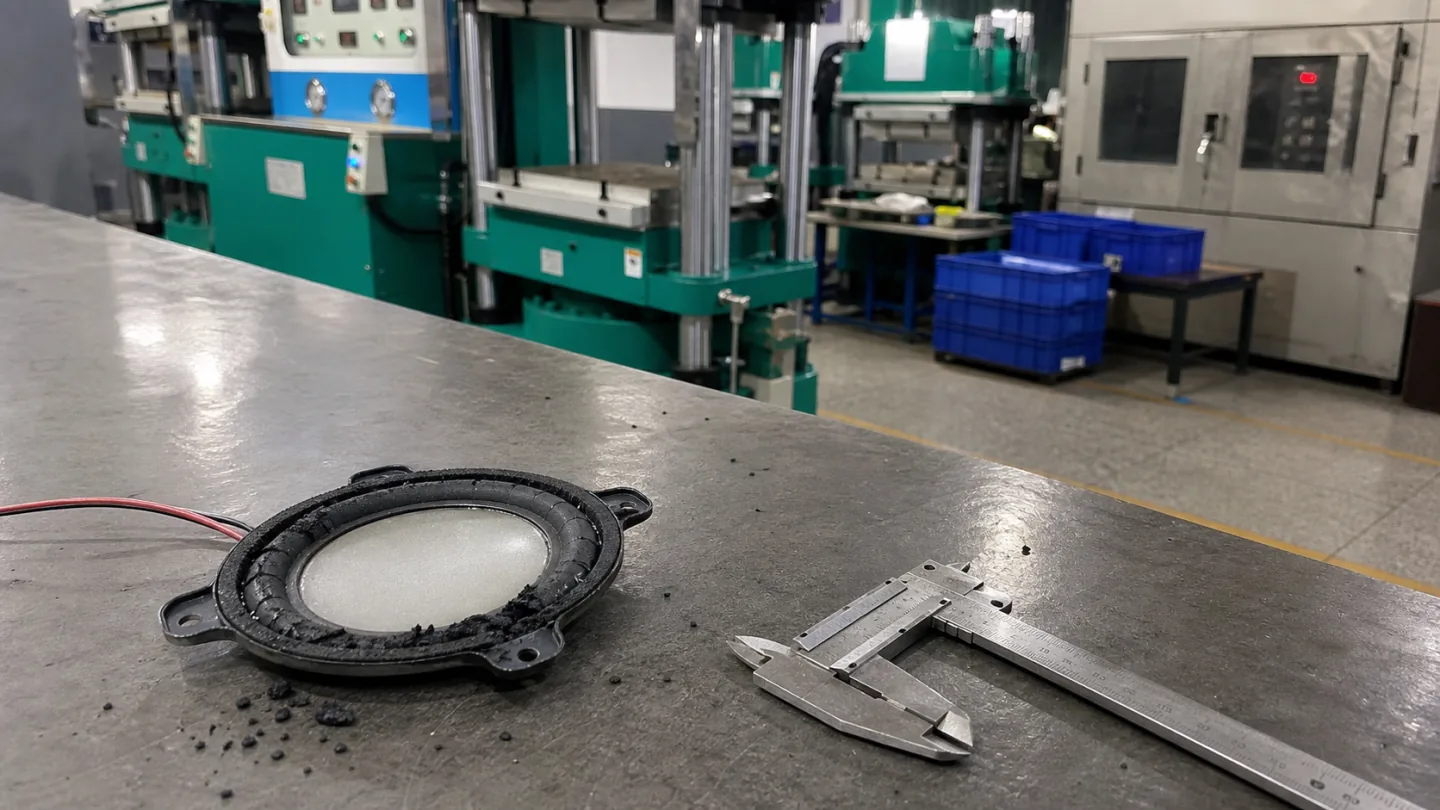
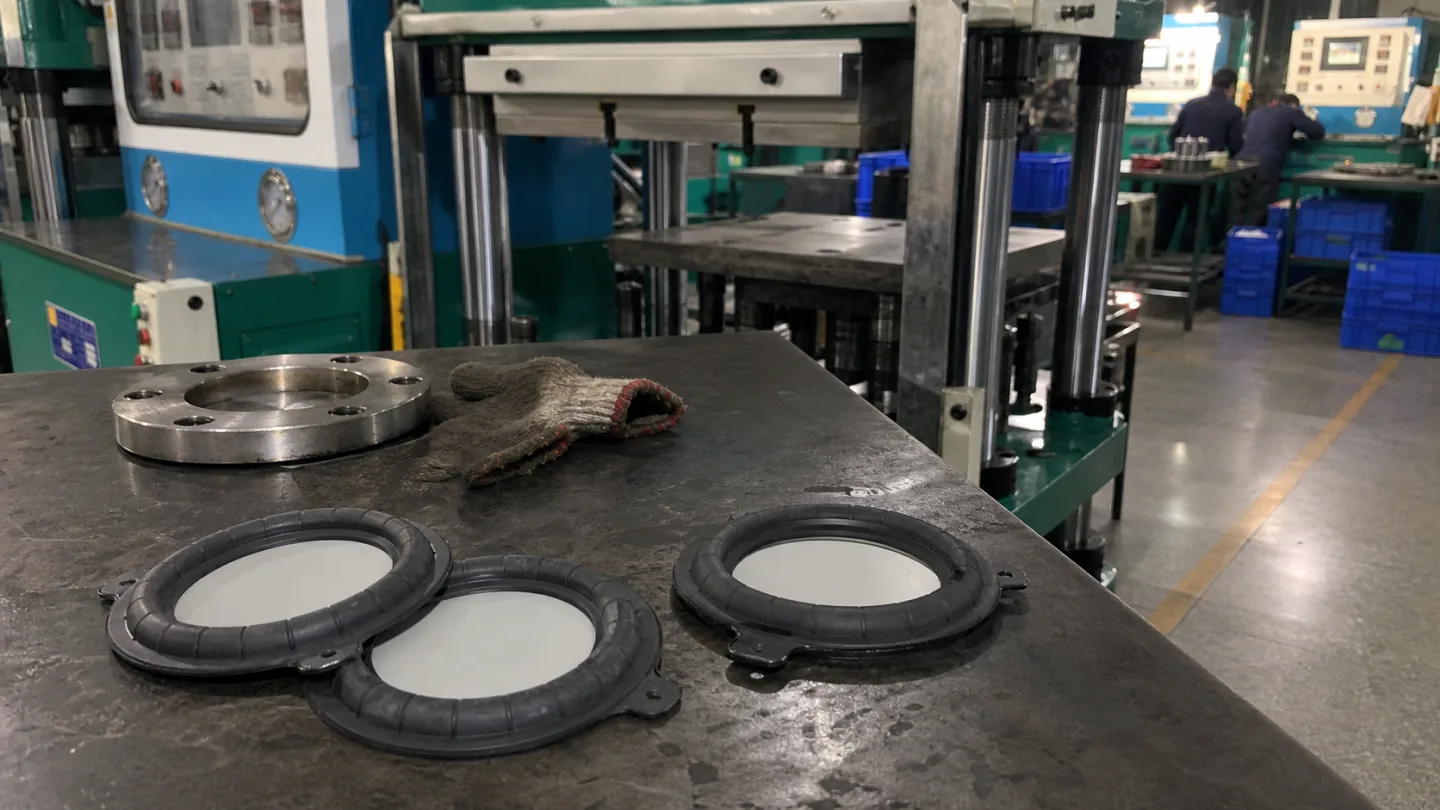
That is why compound development and validation sit together on our floor. Rubber is mixed in-house across three compounding lines, so a formulation change is a process step rather than a supplier negotiation. Every surround batch is checked on an F0 resonance-frequency tester — the measurement that tells you whether unit 500 sits on the same resonance as unit 1, which is what consistent damping means once it leaves the lab. Roll geometry goes on a 2D optical measurement system, because a surround 0.2 mm off its designed profile is a different spring. Add Shore A hardness, tensile, UV ageing and constant temperature-humidity, across incoming, in-process and outgoing inspection. General rubber shops do not own an F0 tester. Acoustic ones cannot work without it.
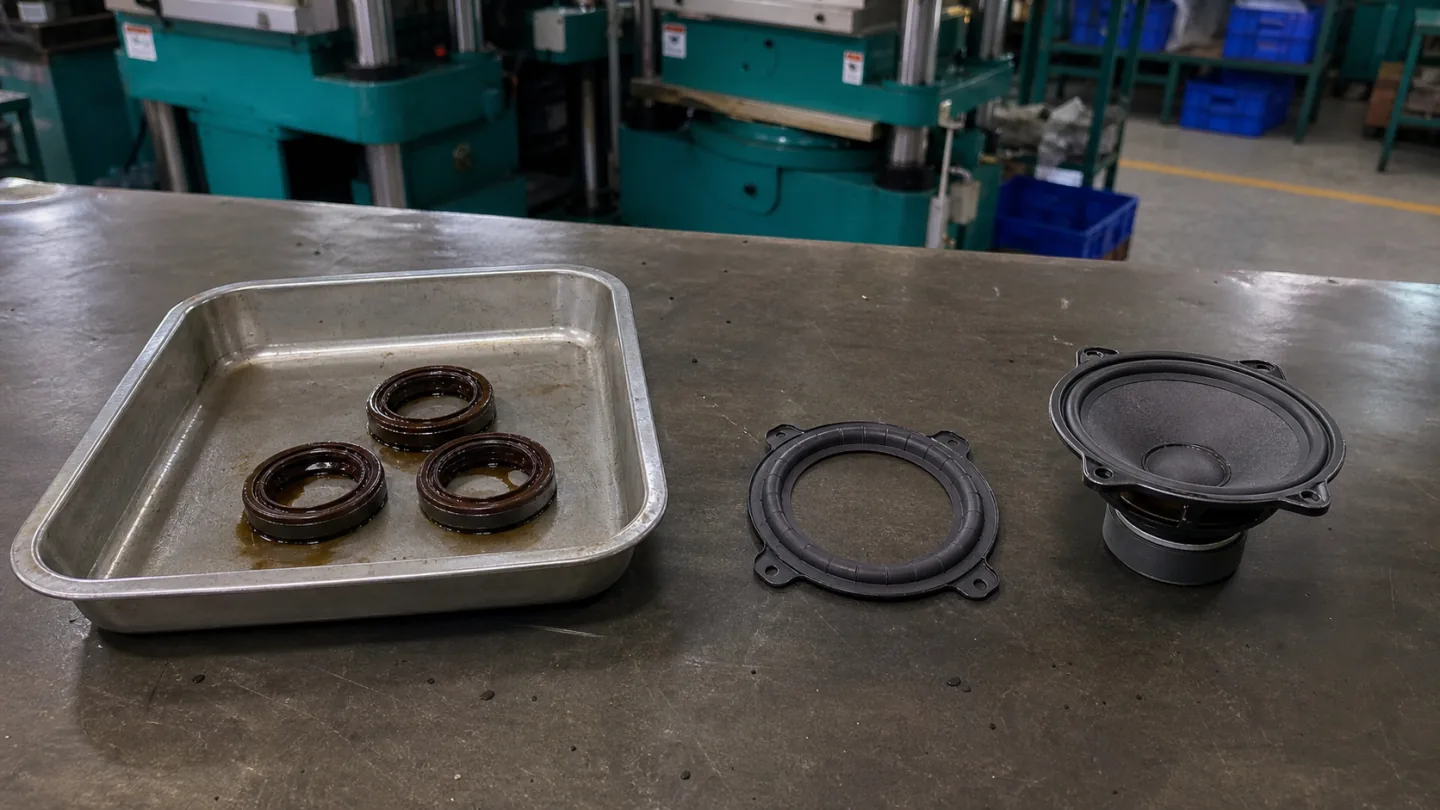
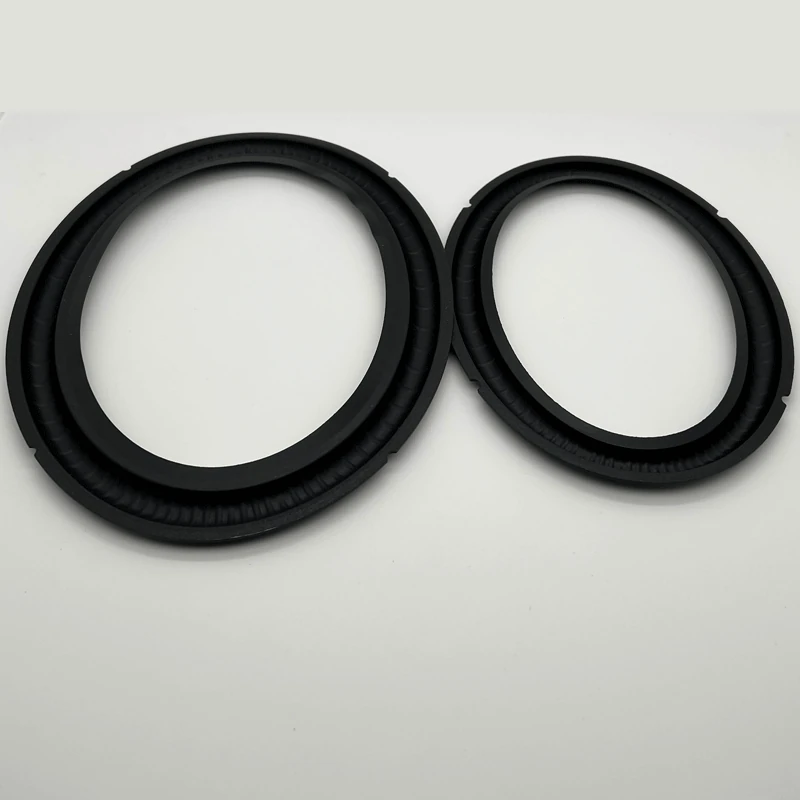
Stock butyl (IIR) surrounds cover the common small-driver sizes, and custom tooling runs to 18". Bring a driver and a target response and our OEM/ODM team works back from it to a compound and a roll profile.
FAQ
Why is butyl used for speaker surrounds instead of cheaper rubber?
Three reasons at once: high internal damping that suppresses cone-edge resonance for cleaner bass, very low air permeability that keeps a sealed box sealed, and strong resistance to ozone, UV and humidity so it does not harden or crack over decades. Cheaper compounds like SBR give up at least one of the three.
Is a butyl surround better than foam?
For durability and damping, clearly — foam rots after roughly a decade and damps less. Foam is lighter and more compliant, so it wins on efficiency and maximum excursion, and it is the correct original spec on many vintage drivers. Match the material to the design goal, not to a ranking.
Do butyl surrounds get stiff in the cold?
Not in normal use. Butyl stays flexible well below freezing, which puts it in the upper range of common surround rubbers for cold tolerance — a driver in an unheated garage or a car door behaves close to normal. Extreme sustained cold is worth flagging at design stage so the compound can be tuned for it.
Can you tell a butyl surround by looking at it?
Not reliably by eye — butyl, EPDM and NBR surrounds all look like black rubber rings. Feel is a better hint: butyl is notably dead, with almost no rebound when flicked. For anything that matters, ask for the compound spec rather than guessing.