A bookshelf pair lands on the shelf at a price where the entire driver — magnet, basket, cone, coil, surround — costs less than a butyl surround alone on a high-end woofer. That project still needs a rubber ring that seals, damps, survives a decade indoors and measures the same on unit 1 and unit 5,000. SBR (styrene-butadiene rubber) is the cost-optimal general-purpose surround compound: moderate damping, good flex fatigue life and excellent batch consistency at the lowest price of any moulded surround rubber, in exchange for weaker ozone, weather and oil resistance than butyl, EPDM or NBR.
That trade bites in specific, nameable places. If none of them describe your driver, SBR is not the cheap option. It is the correct one.
What SBR actually is
SBR is a random copolymer: styrene and butadiene units strung along the same chain in no particular order, typically around 23% styrene by weight in general-purpose grades. The styrene is dispersed, not gathered — no separate hard phase, nothing holding the network together on its own. Like natural rubber, SBR needs a sulfur cure to become a rubber at all, and reinforcing filler to reach useful strength.
The styrene dial, in surround terms
Styrene stiffens the chain and raises the glass transition — and a surround is a spring with a loss term, so both halves move. Push styrene up and more of the cone's edge energy turns to heat instead of reflecting back, but the roll gets stiffer, raising the driver's resonance and stiffening sooner in the cold. Pull it down and the roll gets compliant and cold-tolerant while the damping the design counted on goes soft.
Filler loading and cure system move the same targets again, often further than the base grade does. Two surrounds honestly labelled SBR can produce drivers that measure differently — the recipe is the specification, not the material name. Same lesson butyl teaches, harder here, because the window is wider.
Grade numbers describe a family, not a datasheet. In the IISRP system the 1500 series is cold-polymerised emulsion SBR, the workhorse; the 1700 series is the same thing oil-extended, softer and cheaper per kilo. Solution grades (S-SBR) control molecular architecture more tightly; emulsion grades (E-SBR) run broader and process more forgivingly.
Where SBR belongs
Indoors, on a driver whose service life is honestly matched to its price: entry-level and mid-range bookshelf and tower woofers, multimedia and TV drivers, high-volume consumer lines where the BOM is fought over in single cents. At 20°C and 50% humidity, SBR does the job for a very long time. It damps enough to keep the cone edge civil, flexes for millions of cycles without fatiguing, and moulds repeatably at volume — which matters more than any datasheet number when you ship thousands a week. (It is everywhere outside audio for the same reasons: tyres, footwear, belting.)
Where SBR is the wrong call
Three cases. Weather: SBR's backbone carries the double bonds ozone and UV attack, and antiozonants buy time, not immunity — an outdoor or marine driver should be EPDM. Oil and fuel contact: SBR swells; that is NBR's job. Damping-critical designs: SBR damps moderately, butyl damps far more, and chasing the last decibels of edge-resonance control on a serious woofer is not a place SBR formulation reaches.
| Requirement | SBR | Butyl (IIR) | EPDM | NBR |
|---|---|---|---|---|
| Relative unit cost | Lowest | Moderate | Moderate | Higher |
| Internal damping | Moderate | Excellent | Moderate | Moderate |
| Sealed-box air retention | Fair | Excellent | Good | Good |
| Ozone / UV / weather | Poor | Excellent | Excellent | Poor |
| Oil / fuel contact | Poor | Poor | Poor | Excellent |
| Flex fatigue life | Good | Good | Good | Good |
| Typical home | Indoor, cost-driven volume | Hi-fi woofers | Outdoor / marine | Oil-exposed, industrial |
Read the cost row against the rest. SBR is not a worse butyl — it answers a different question. If the driver lives indoors and the price has to work, paying for ozone resistance it will never use is not engineering. It is decoration. Sorting this out at design stage is what choosing a surround material is for; rubber vs foam covers the other axis.
Cheap material, not cheap process
The failure mode on budget surrounds is never the polymer. It is the shop. A cheap compound only helps if part 5,000 behaves like part 1, and that is a mixing and moulding problem.
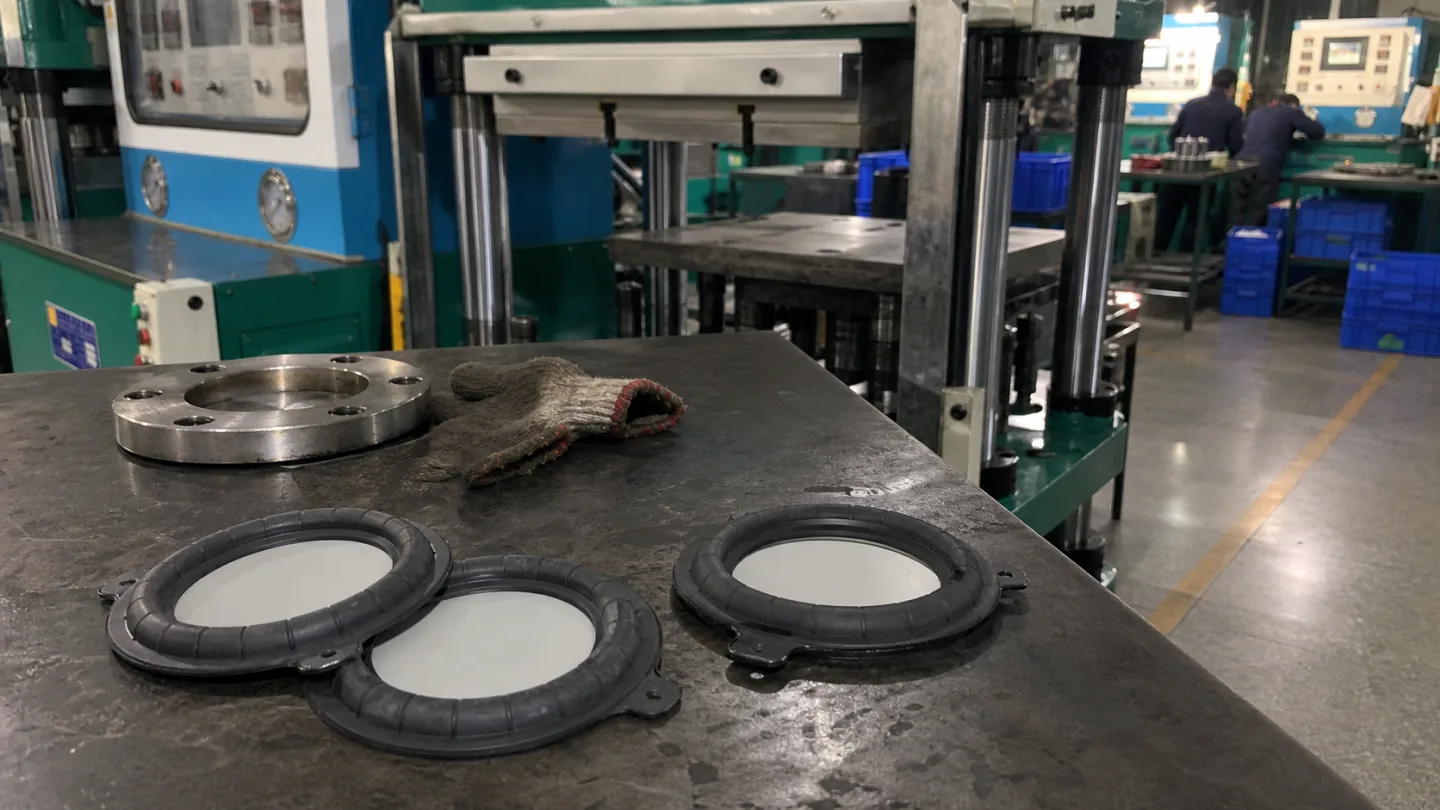
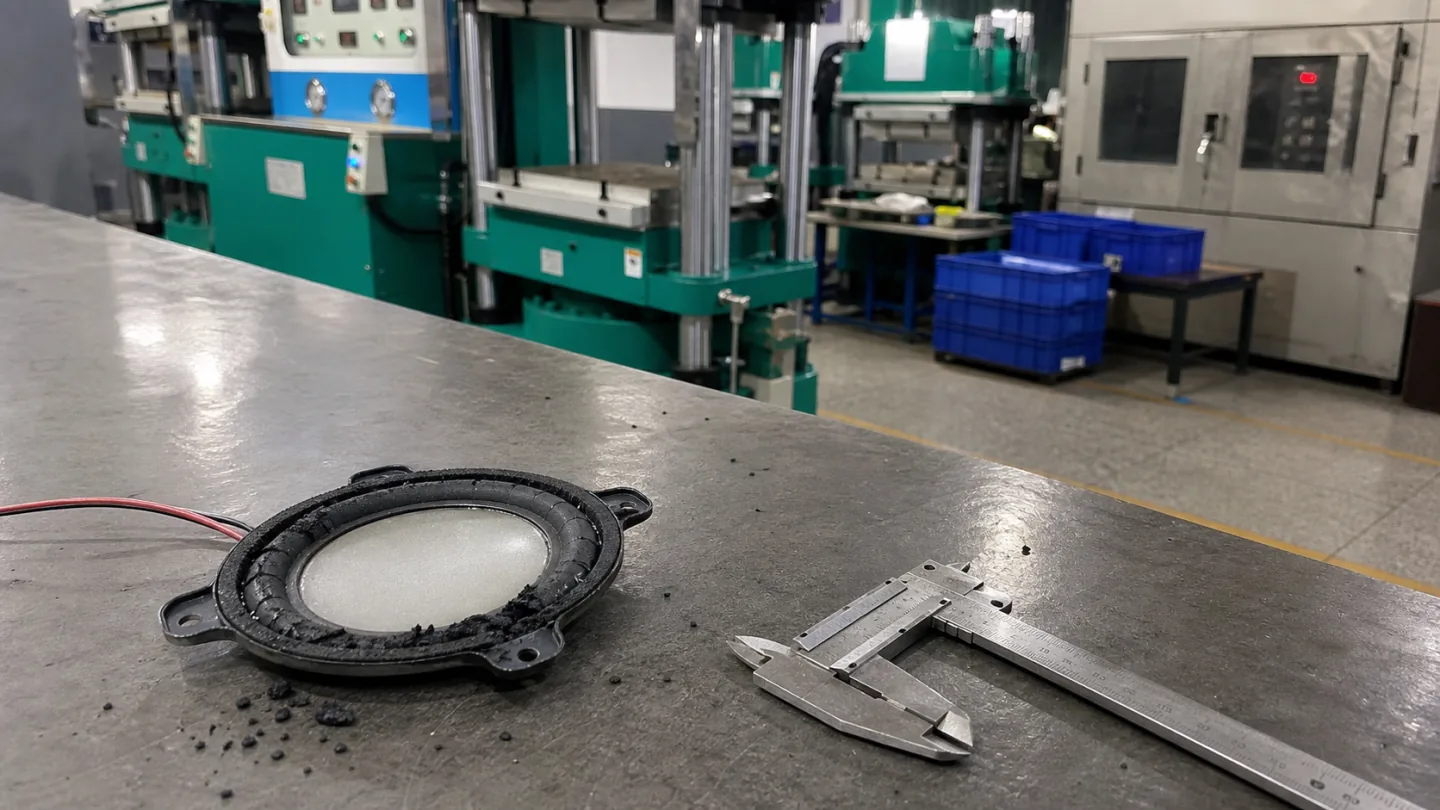
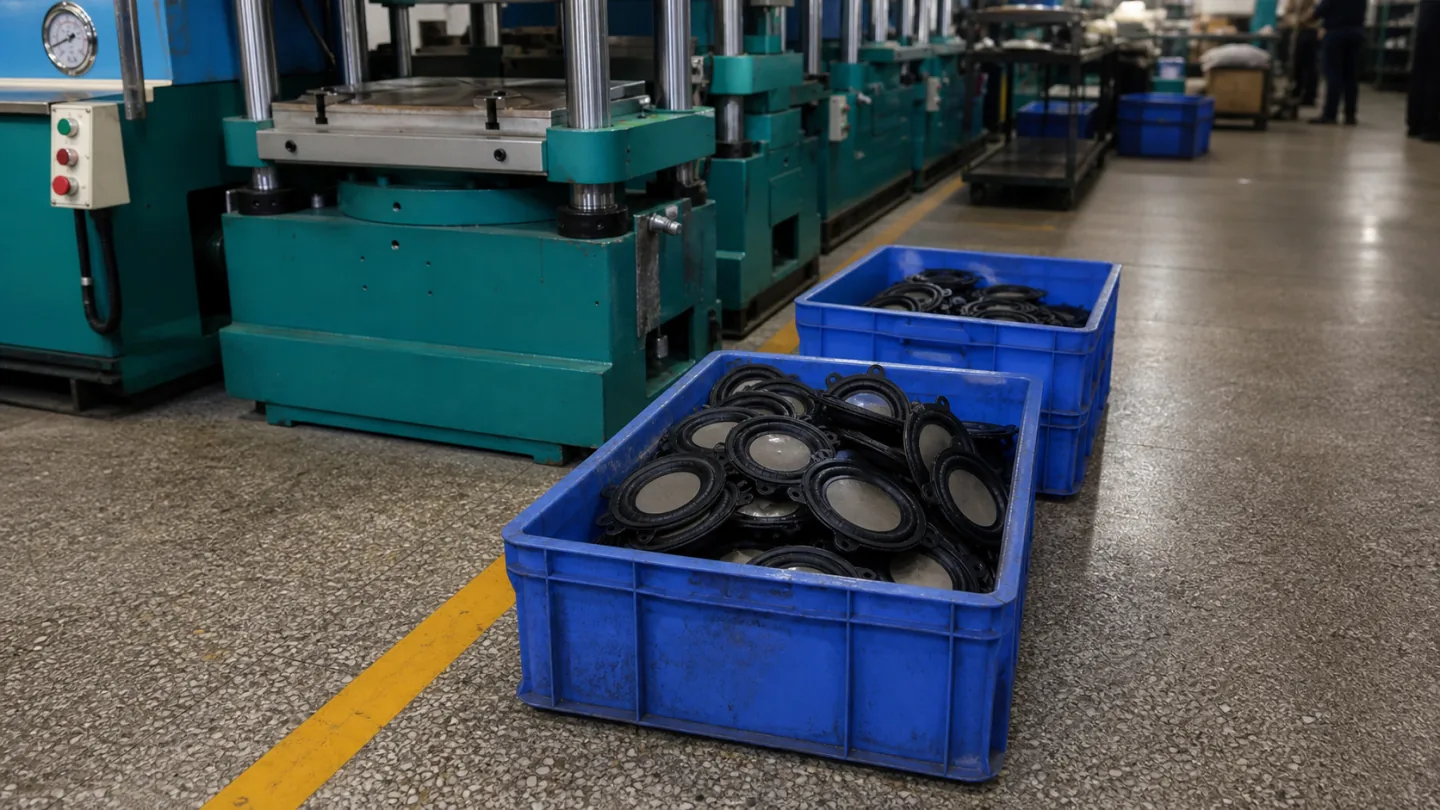
Rubber is mixed in-house here across three compounding lines, so a styrene or filler adjustment is a process change rather than a supplier negotiation. Moulding runs on 25 hydraulic press sets. Every batch goes on the F0 resonance-frequency tester — the check that says whether the compliance you specified is the compliance you got, unit after unit. Roll geometry goes on a 2D optical measurement system, because a profile 0.2 mm off spec is a different spring whatever the rubber is. Shore A hardness, tensile, salt spray and UV ageing back that up across incoming, in-process and outgoing inspection. QC does not get cheaper because the compound did.
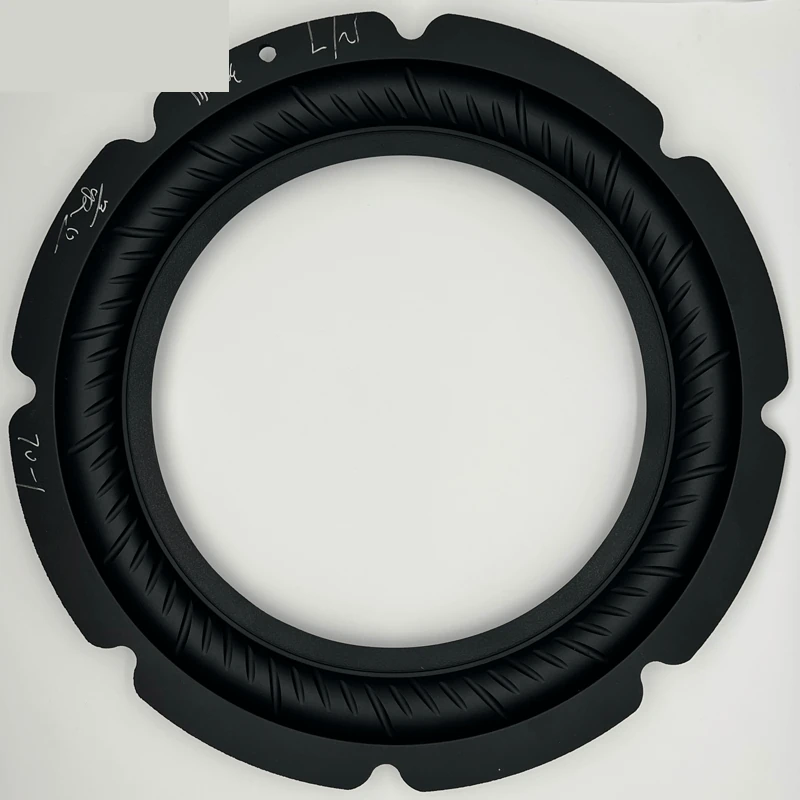
Stock SBR surrounds cover the common sizes; custom tooling runs 2" to 18". If the answer turns out to be butyl, EPDM, NBR or foam, those are on the same floor. Bring a target response and a BOM ceiling to our OEM/ODM team.
FAQ
Is an SBR speaker surround worse than butyl?
For damping, air retention and weather resistance, yes — butyl wins all three. On an indoor driver at a consumer price point, none of those gaps show up in the listening room within the product's expected life, and SBR costs meaningfully less. Match the material to the design goal, not to a ranking.
What does styrene content change in an SBR surround?
Higher styrene makes the rubber harder, more damped and less resilient, but stiffer in the cold and less compliant — which raises the driver's resonance. Lower styrene softens the roll and improves cold flexibility at the cost of damping. General-purpose grades sit near 23% and get tuned from there.
How long does an SBR surround last?
Indoors, longer than most consumer speakers stay in service — flex fatigue is not the limit. Sustained UV, ozone or outdoor exposure is another story: that is where SBR hardens and crazes first, and where EPDM should have been specified instead.
Can SBR be used for car speakers?
In a door card, with care — it is done at volume. The concerns are heat cycling, humidity and oil or solvent contact, so the compound has to be tuned for that duty rather than lifted from an indoor bookshelf spec. Where the exposure is real, butyl or EPDM is safer.