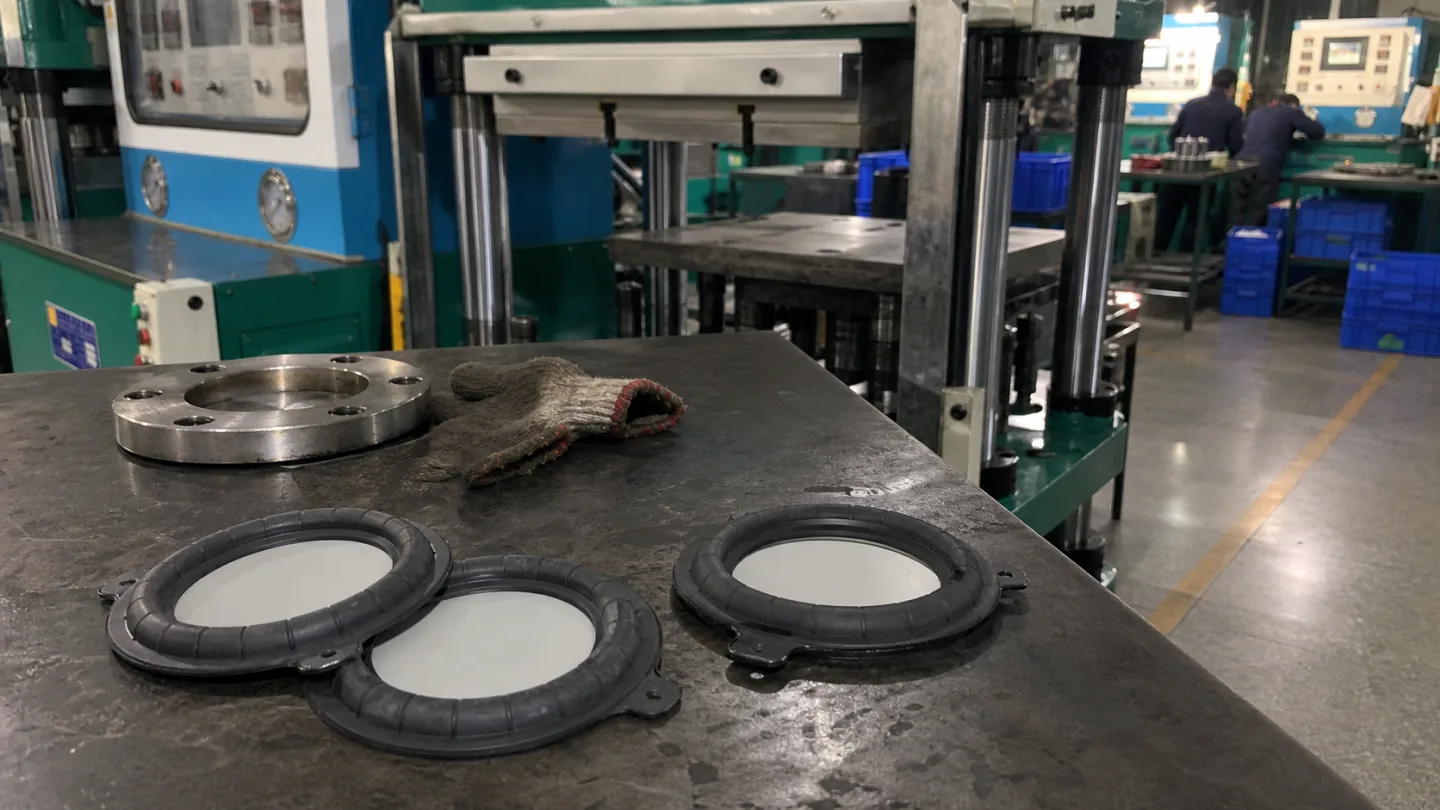
An enquiry landed a while back for a 6.5" surround in ACM. The customer was building a driver for an engine-bay enclosure — warm, occasionally oily — and had gone looking for the toughest heat-and-oil rubber on the chart. ACM came top. So the spec said ACM.
Reasonable read of a chart, wrong call for the part. ACM (acrylic rubber) is a specialist for one narrow job — staying elastic in hot mineral oil for years — and a speaker surround is not that job. Worth walking through why, because the same reasoning sorts out most surround material questions.
What ACM is genuinely good at
ACM is an alkyl acrylate copolymer, and two structural facts explain it.
The backbone is saturated — no double bonds along the main chain, nothing there for oxygen or ozone to attack. Same trick that makes butyl and EPDM age so well, and it is why ACM tolerates sustained heat that turns nitrile hard and glassy.
Hanging off that backbone are polar ester side groups. Mineral oil, ATF and gear oil are non-polar; polar and non-polar do not mix, so oil struggles to get into the network and swell it. Heat resistance from the backbone, oil resistance from the side chains — a rare pairing, and the reason ACM ended up inside automatic transmissions, on oil pan gaskets, and around turbo ducting. Fluoroelastomers do that job better at multiples of the price; nitrile gives up as oil temperature climbs. ACM owns the band in between.
One detail most write-ups mangle: ACM cannot be cured with sulfur, because a saturated backbone gives sulfur nothing to bridge. Peroxide is not the answer either — with no useful crosslink chemistry there, peroxide radicals mostly drive chain scission rather than network formation. Industry cures ACM through dedicated cure-site monomers built into the polymer: amine onto carboxyl or epoxy sites, soap/sulfur onto chlorine sites. The amine reacts with the cure site, not the ester side chains — attacking those would be degradation, not vulcanisation.
Why a surround is a different problem
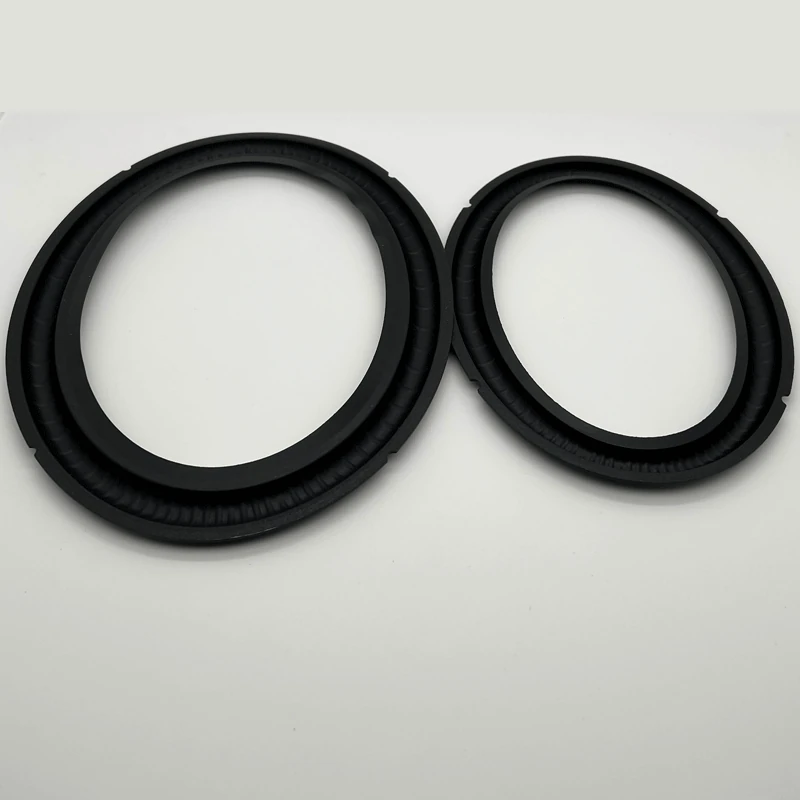
A surround is not a seal. It is a spring with a damping specification, and it lives nowhere near hot oil.
The damping is wrong — that is what decides it. A surround terminates the travelling waves coming off the cone edge and turns them into heat instead of reflecting them back. Butyl is the benchmark: flick an offcut and it thuds. ACM is engineered for elastic recovery, because a seal that swallows energy instead of pushing back takes a set and leaks. Opposite targets. You cannot buy a surround-grade loss factor from a compound family tuned for compression set.
Water and cold are real problems. The ester groups that repel oil are hydrolysable — humidity, condensation, a coastal living room, a car door that gets wet are ordinary surround conditions and a slow chemical attack on ACM. It also stiffens well before butyl does, and a driver in an unheated garage still has to move as designed on a winter morning. Butyl and EPDM shrug off both.
The oil resistance buys nothing. No surround is immersed in oil. Even in an engine bay the edge of a cone sees warm air, maybe some mist — a spec butyl and EPDM meet without a price premium. ACM costs several times a general-purpose surround compound, for a property the part never uses.
ACM vs butyl vs EPDM — as a surround
| What a surround needs | ACM | Butyl (IIR) | EPDM |
|---|---|---|---|
| Internal damping (clean bass) | Poor — tuned for elastic recovery | Excellent — the benchmark | Moderate |
| Sealed-box air retention | Moderate | Excellent | Good |
| Ozone / UV / long-term ageing | Excellent | Excellent | Excellent |
| Humidity, water, condensation | Poor — esters hydrolyse | Excellent | Excellent |
| Cold flexibility | Fair — stiffens early | Good | Excellent |
| Hot oil immersion | Excellent — and irrelevant here | Poor | Poor |
| Relative cost | High | Moderate | Moderate |
ACM wins one row — the row a surround never has to satisfy — and loses the two that decide whether the driver sounds right.
So what should your driver use?
For most drivers the live decision is butyl or EPDM, not whether an exotic belongs in the box. Still open? Start at choosing a speaker surround material.
- Hi-fi, studio, sealed-box bass → butyl (IIR). Damping is the whole argument.
- Outdoor, marine, car door, wide temperature swing → EPDM. Weather and cold, no hydrolysis exposure. Where that flips: butyl vs EPDM.
- Genuine oil or fuel contact near the driver → NBR. Oil resistance at surround compliance.
- Maximum efficiency, minimum moving mass → foam, accepting the service life. See rubber vs foam.
- Cost-driven volume builds, mild environment → SBR.
That engine-bay enquiry ended in EPDM. Heat and weather were the actual constraints; hot-oil immersion never was.
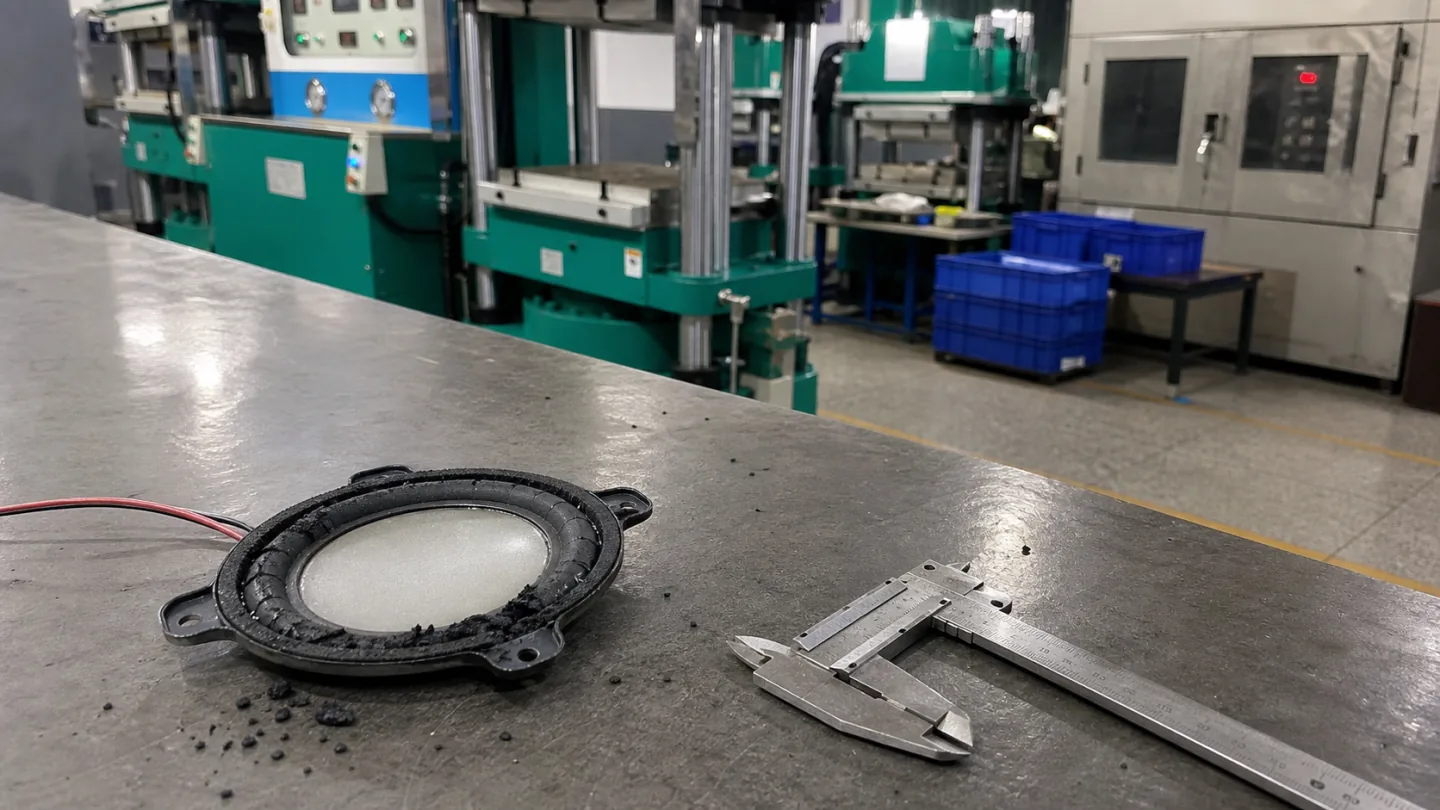
We can argue about this rather than just quote it because compounds are mixed in-house and validated on the same floor. Every batch goes on the F0 resonance-frequency tester — the measurement that tells you whether the damping you specified is the damping unit 500 actually has. Roll geometry goes on the 2D optical measurement system, since a profile 0.2 mm off design is a different spring. Shore A, tensile, UV ageing and constant temperature-humidity run across incoming, in-process and outgoing inspection. Bring a driver and a target response to the OEM/ODM team and the compound gets worked backwards from it.
FAQ
Can ACM be used for a speaker surround at all?
You could mould one, and it would be a poor surround. ACM is formulated for elastic recovery in hot oil, not the high internal damping a cone edge needs, and its ester chemistry is vulnerable to humidity and condensation — ordinary conditions for a speaker. Butyl or EPDM does the job better and costs less.
Is ACM better than butyl because it handles higher temperatures?
Better for a transmission seal, not a surround. Heat resistance is not the binding constraint on a cone edge; damping, air retention and moisture tolerance are, and butyl leads all three. A material chart ranks properties, not suitability.
Why can't ACM be vulcanised with sulfur or peroxide?
Its saturated backbone gives sulfur no double bonds to bridge. Peroxide is not a fix either: without suitable crosslink chemistry, the radicals tend to break chains rather than build a network. ACM cures through cure-site monomers built into the polymer — amine onto carboxyl or epoxy sites, soap/sulfur onto chlorine sites.
My driver sits in a hot, oily engine bay. What should I spec?
Separate the exposures. Sustained heat plus weather is an EPDM question; actual oil or fuel contact on the surround is an NBR question. Only years of immersion in hot oil reaches ACM territory, and no surround lives there. Tell us the environment rather than the material.