A design engineer once asked us for silicone surrounds on an outdoor driver because "silicone is the tough one." It wasn't the wrong instinct, but it was the wrong reason — the part needed to survive a Florida rooftop, and EPDM would have done it for a fraction of the cost. Silicone earns its place in audio, just not everywhere people assume. Silicone rubber (VMQ) is worth specifying when a part must survive an extreme temperature range, hard UV and weathering, or needs to be light-transmitting, flame-retardant or color-matched — and it is the wrong call when acoustic damping, tear strength or unit cost drives the design.
What VMQ actually is
Silicone rubber runs on a silicon-oxygen backbone rather than the carbon-carbon chain in butyl, EPDM or NBR. That one structural difference explains nearly everything that follows — the good and the bad. Under ASTM D1418 the general-purpose grade is VMQ (vinyl-methyl). Two variants matter here: PVMQ, phenyl-modified, which pushes usable low-temperature performance further down, and FVMQ, fluorosilicone, which trades cost for fuel and solvent resistance. For speaker parts VMQ covers most of the ground; PVMQ shows up when a driver has to work somewhere genuinely arctic.
The headline number: general-purpose VMQ holds up roughly −60 °C to +250 °C in continuous service. No other common elastomer spans that. Butyl gets uncomfortable well before the top end and EPDM isn't much better; silicone is still flexible at both extremes rather than glassy at one and softening at the other.
The real strengths
- Temperature range — the one nobody else matches. A part near a class-D amp board, or a driver where cabin temperature swings hard, doesn't drift in stiffness the way a carbon-backbone compound does.
- UV, ozone and weathering — the siloxane backbone has no double bonds for ozone to attack. Silicone doesn't chalk, crack or go brittle in sunlight. EPDM is excellent here too; silicone is simply harder to beat.
- Low compression set — a silicone gasket clamped under a driver flange for three years still pushes back. That's what separates a seal that holds from one that leaks quietly at year two.
- Low odor and low volatiles — properly post-cured silicone doesn't off-gas into a sealed cabinet or leave a smell in a retail box.
- Formulation freedom — light-transmitting, flame-retardant and custom-color grades are straightforward in silicone, which is why it shows up where the rubber is meant to be seen.
The weaknesses worth saying out loud
The same backbone that shrugs off UV is vulnerable to something else entirely: strong alkali hydrolyses the siloxane chain. Concentrated caustic cleaning agents will attack silicone in a way they won't touch EPDM. High-pressure steam is the same story — silicone is not the material for a repeated superheated-steam environment, despite its heat rating implying otherwise. Dry heat and wet heat are different problems.
Beyond chemistry, three mechanical facts cost silicone jobs:
- Low damping. Silicone has low internal loss. For a surround, that's not a neutral trait — the surround is supposed to absorb energy at the cone edge, and butyl's high damping is precisely why it dominates premium woofers. Silicone lets more of that energy come back.
- High gas permeability. Silicone is one of the most gas-permeable elastomers there is; butyl is one of the least. In a sealed enclosure that difference is not academic.
- Tear and abrasion strength. Silicone tears more readily than a well-compounded general-purpose rubber, which matters on thin roll sections and during handling.
And cost. Silicone compound sits well above SBR, NBR or EPDM. That alone decides a lot of programs.
Silicone vs butyl vs EPDM in a speaker
| Property | Silicone (VMQ) | Butyl (IIR) | EPDM |
|---|---|---|---|
| Continuous temp range | −60 to +250 °C | Narrow | Moderate |
| UV / ozone / weathering | Excellent | Good | Excellent |
| Acoustic damping | Low | High — best in class | Moderate |
| Gas permeability | High (poor sealing) | Very low (best sealing) | Low |
| Compression set | Low — excellent | Moderate | Good |
| Alkali / high-pressure steam | Poor | Good | Good |
| Tear strength | Fair | Good | Good |
| Light-transmitting option | Yes | No | No |
| Relative cost | High | Moderate | Low–moderate |
Where silicone belongs in audio
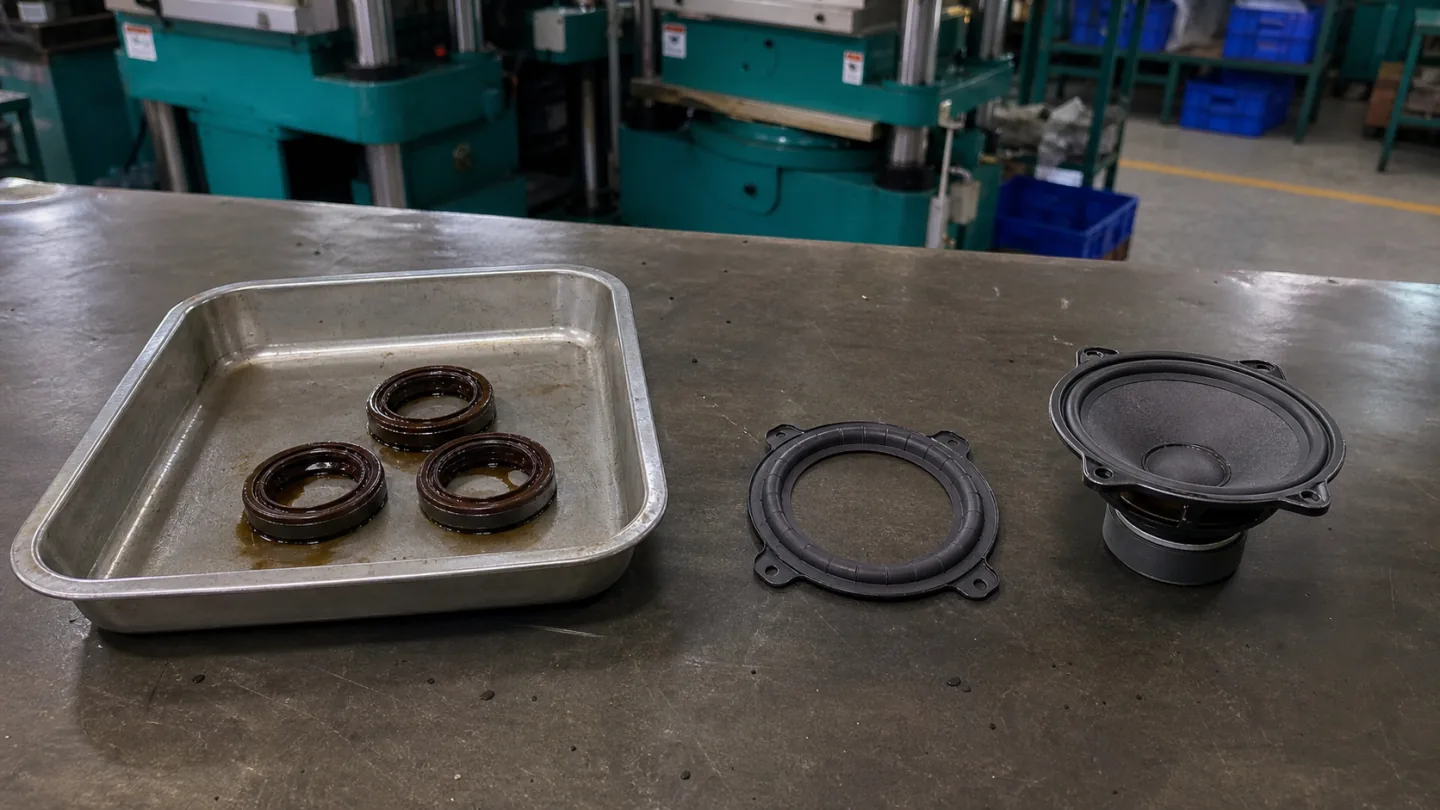
Surrounds — specify silicone when the driver lives somewhere thermally brutal, when a flame-retardant grade is required, or when the surround is visible and has to transmit light or match a brand color. For a conventional hi-fi woofer chasing clean, controlled bass, butyl still wins on damping; that trade-off is laid out in our surround material guide.
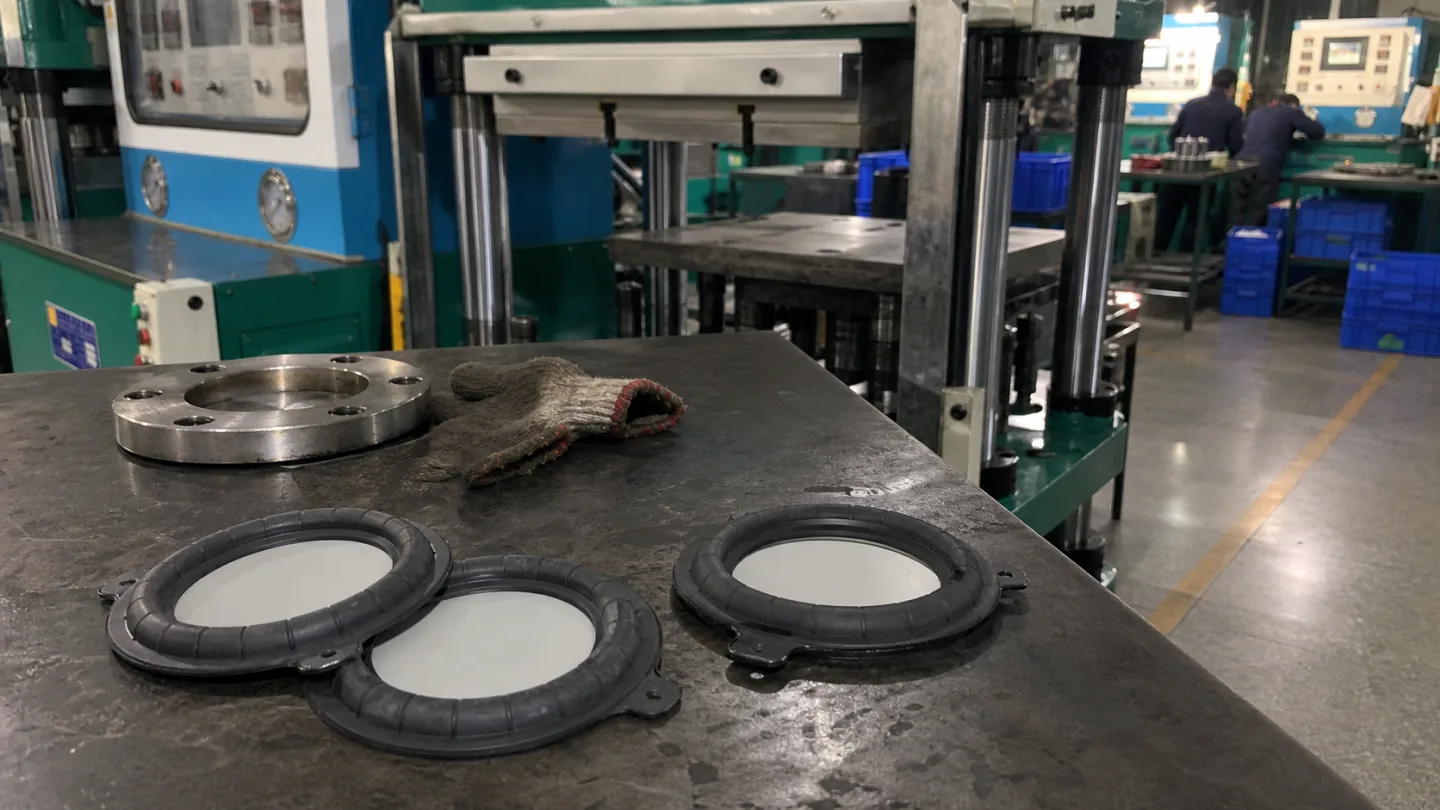
Passive radiator diaphragms — a PR has no motor and no voice coil, so it's driven purely by cabinet pressure. Silicone's formulation freedom pays off here: light-transmitting and custom-color PRs are a genuine industrial-design lever, and flame-retardant grades cover enclosed builds. Background on the part itself is in what a passive radiator diaphragm does.
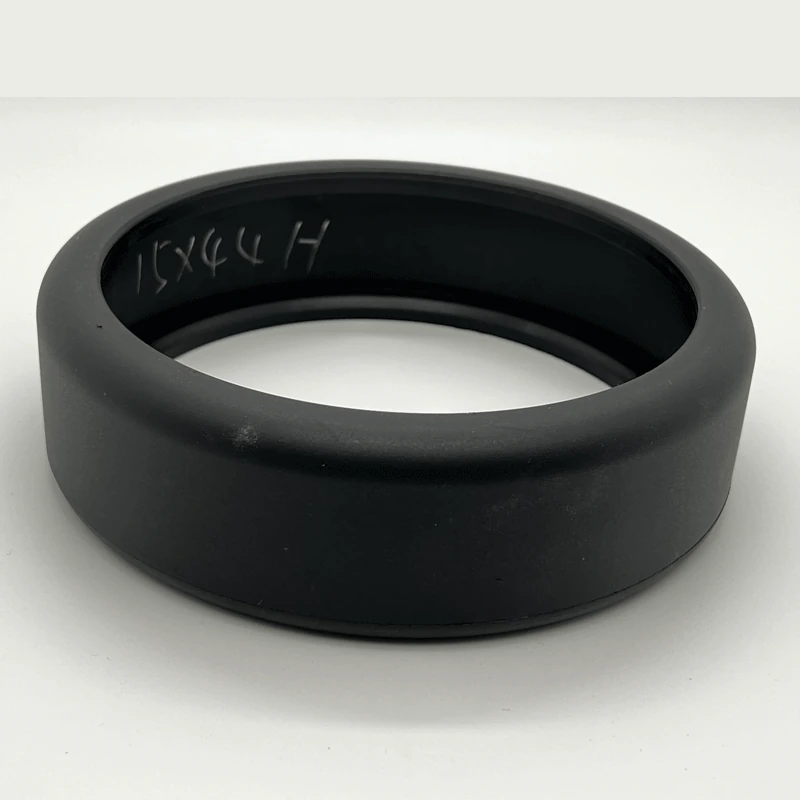
Seals and gaskets — low compression set plus weathering is a strong combination for driver-mount gaskets on outdoor and automotive builds, as long as nothing caustic is in the cleaning cycle. The wider family of molded parts is covered in molded silicone and rubber parts for audio.
Proving a silicone part behaves
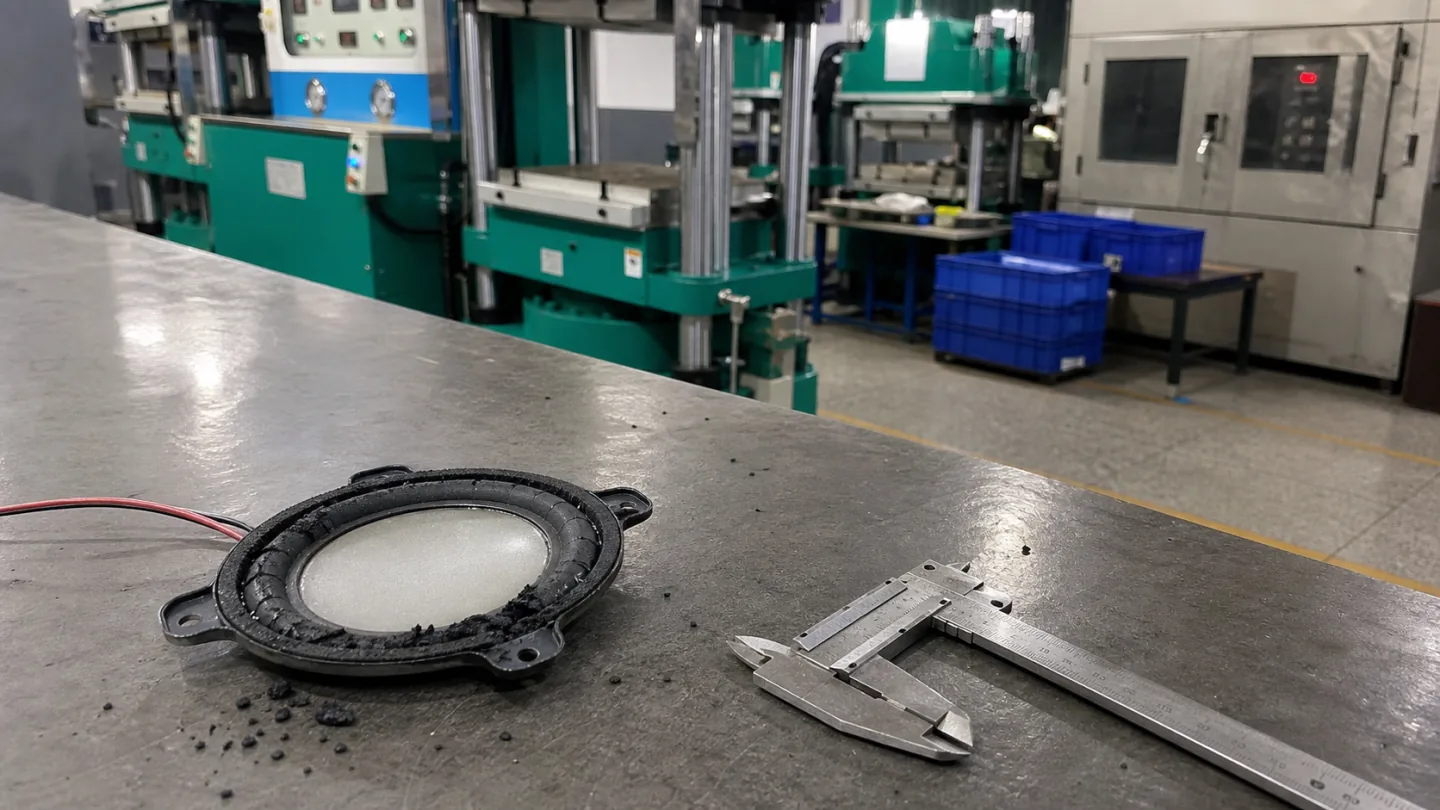
A silicone surround's value is a durability claim, and a durability claim needs a chamber behind it. UV-aging, salt-spray, constant temperature-humidity and outdoor weathering rigs make those claims falsifiable rather than aspirational. F0 resonance testing catches the acoustic consequence of a compound change — silicone's modulus and damping move a driver's resonance, and that has to be measured, not assumed. Two-dimensional optical measurement holds roll profile and outer diameter across a run, and inspection runs incoming, in-process and outgoing so a compound that drifted at mixing never becomes a field return. Talk through a compound choice with our custom service team before it becomes a tooling decision.
FAQ
What temperature range can silicone rubber handle?
General-purpose VMQ works continuously from roughly −60 °C to +250 °C — a wider span than butyl, EPDM or NBR. Phenyl-modified PVMQ extends usable low-temperature flexibility further down, which is the grade to ask about for genuinely cold environments.
Is silicone rubber chemically resistant?
Selectively. It resists UV, ozone, weathering and oxidation extremely well. It is poor against strong alkali, which hydrolyses the siloxane backbone, and it does not do well under repeated high-pressure steam. For fuel and solvent exposure, fluorosilicone (FVMQ) is the variant to consider.
Should I use silicone or butyl for a speaker surround?
Butyl for most hi-fi and subwoofer work — its high damping and very low gas permeability suit sealed enclosures and clean bass. Silicone when the application demands extreme temperature range, a flame-retardant grade, light transmission or a custom color, and the cost and lower damping are acceptable.
Can silicone surrounds and passive radiators be made in custom colors?
Yes. Custom color, flame-retardant and light-transmitting silicone grades are all available for surrounds and PR diaphragms across the 2"–18" range, alongside standard rubber and foam options on our products page. Sampling typically runs 3–7 days.