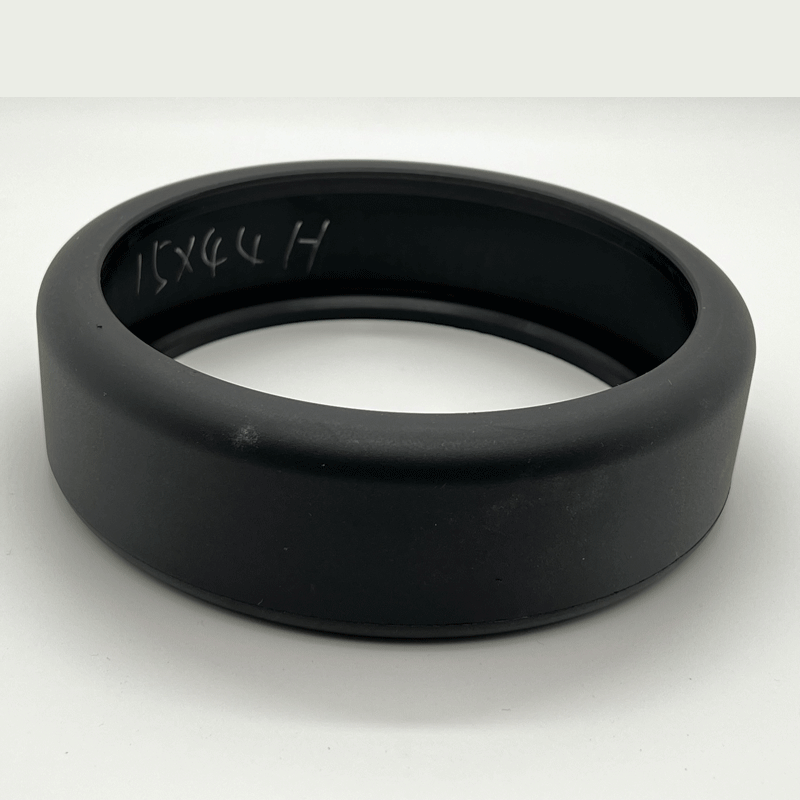
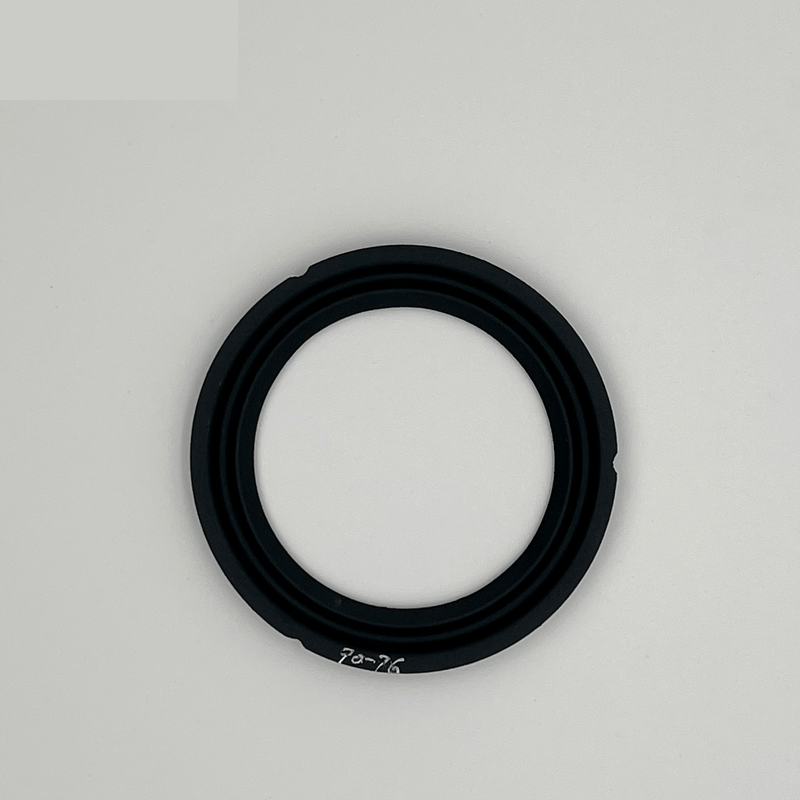
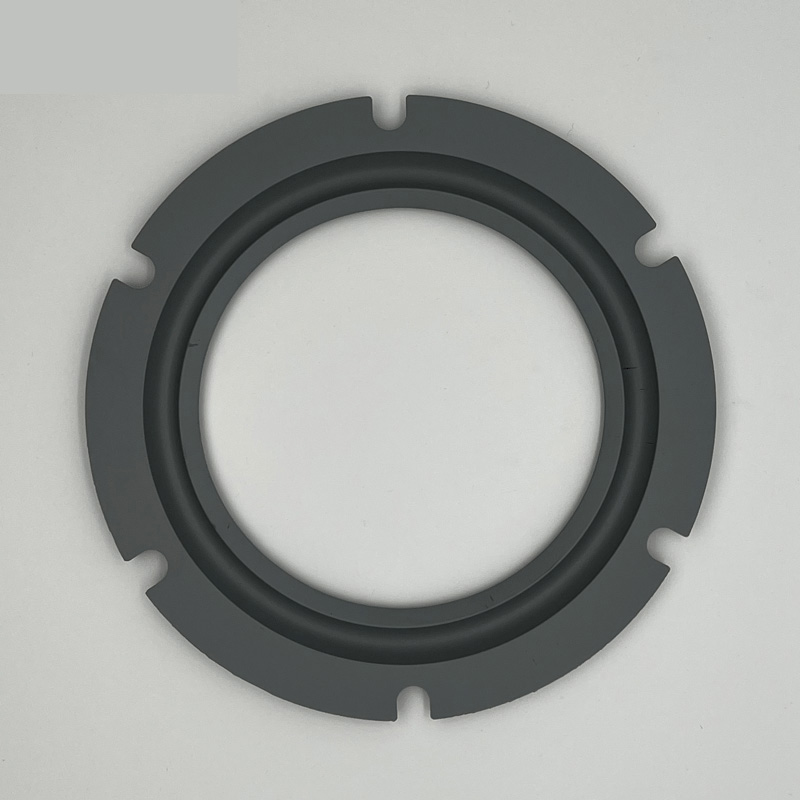
Take two surrounds off two different production runs, months apart. Same drawing, same nominal diameter, same supplier even. Drop them on a caliper and they both pass. Mount them on identical drivers and play the same tone, and one woofer sounds slightly looser, slightly less controlled — a little more air in the low end than it should have. Nothing on the spec sheet explains it, because the spec sheet only asked about size.
That gap is where most quality problems in speaker rubber actually live. A surround isn't just a ring of material cut to a diameter — it's a spring. Its stiffness, damping and mass all feed into how the cone moves, and none of those show up on a caliper reading. A shop that only measures dimensions can ship a part that is technically correct and acoustically wrong.
The measurement a generic rubber shop skips
Ask a general-purpose rubber molder how they check a gasket or a seal, and the answer is usually dimensional: calipers, maybe a thickness gauge, a visual pass on flash and finish. That's a reasonable bar for a part whose job is to seal or cushion. It is not a reasonable bar for a part whose job is to resonate at a controlled frequency thousands of times a second.
An acoustic-rubber specialist adds a test built specifically for that job: an F0 resonance-frequency tester. Instead of asking "is this the right size," it asks "does this surround behave the right way" — checking the resonant frequency the part contributes to the driver, batch after batch. Hardness drift, cure variation, compound aging in storage — all of it can nudge a surround's stiffness without ever showing up as an out-of-tolerance dimension. F0 testing is what catches that before a container of parts ships and a customer's QA team hears the difference on the bench.
Alongside it sits 2D optical measurement — an imaging system that checks dimensional and profile accuracy far more precisely than a hand caliper, and does it on the actual roll profile of the surround, not just an outer diameter. The roll shape (the cross-section of the fold) governs compliance and excursion just as much as diameter does, and it's exactly the kind of detail a quick caliper check can wave through while still being wrong.
What that looks like on the floor
Neither tool works as a one-off spot check. They sit inside three inspection stages that run on every job, not just the ones a customer happens to ask about:
- Incoming inspection — raw compound and pre-forms are checked before they enter production, including tensile strength and Shore A hardness, so a bad batch of rubber never gets that far.
- In-process inspection — dimensional and optical checks run while parts are being molded, catching drift as it happens rather than after a full run is already boxed.
- Outgoing inspection — finished parts are re-checked before they ship, with F0 and optical measurement confirming the batch matches the last one, not just the drawing.
For parts destined for outdoor, automotive or marine use, that same QC line runs salt-spray and UV-aging exposure plus constant-temperature-and-humidity testing, so a part rated for a car door or a boat deck has actually seen the conditions it will live in, not just a datasheet claim about them.
Acoustic QC vs. a generic rubber shop
| Check | Generic rubber shop | Acoustic-rubber specialist |
|---|---|---|
| Dimensional accuracy | Calipers, spot checks | 2D optical measurement on the full profile |
| Acoustic consistency | Not tested | F0 resonance-frequency testing, batch to batch |
| Material verification | Visual / occasional | Tensile strength and Shore A hardness at incoming inspection |
| Environmental durability | Rarely tested | Salt-spray, UV aging, constant temp/humidity |
| Inspection stages | Often outgoing only | Incoming, in-process, outgoing |
None of this is exotic equipment — it's what you'd expect from a factory that treats surrounds, foam edges and passive-radiator diaphragms as acoustic components rather than generic molded rubber. It's also why a caliper-only supplier can look identical to an acoustic specialist on a first sample and still drift on run three.
Why this matters more as volume goes up
A single prototype can be babied by hand — checked, re-checked, tweaked until it's right. Production doesn't work that way. Once you're running hundreds or thousands of a SKU across multiple molding cycles, the only way consistency survives is if the measurement catches drift automatically, at every stage, rather than relying on someone's trained eye. That's the real value of F0 and optical checks: not that they make one part better, but that they make part 4,000 match part 1.
If you're evaluating a supplier for rubber or foam surrounds, molded silicone parts, or a new passive-radiator diaphragm, ask what they measure beyond size — and at which stage. The answer tells you more about long-run consistency than any single sample ever will. You can see the range we produce on our products page, talk through a spec on our custom service page, or get a closer look at the QC floor itself on our factory page.
FAQ
What is F0 resonance testing and why does it matter for surrounds?
F0 testing measures the resonant frequency a surround contributes to a driver, rather than just its dimensions. Because stiffness and damping affect resonance without necessarily showing up as a size error, F0 testing catches batch-to-batch drift that a caliper check would miss.
How is 2D optical measurement different from using calipers?
Optical measurement images the part's actual profile — including the roll cross-section that governs compliance — at higher precision and consistency than a hand caliper spot check, which typically only samples an outer diameter.
What are the three stages of QC in speaker rubber production?
Incoming inspection checks raw compound and pre-forms (tensile, Shore A hardness) before production starts. In-process inspection checks dimensions and profile while parts are molded. Outgoing inspection re-verifies finished parts, including F0 and optical checks, before they ship.
Does acoustic-grade QC apply to gaskets and molded silicone parts too?
The three-stage incoming/in-process/outgoing structure and the tensile/Shore A/environmental testing apply across gaskets, seals and molded silicone parts as well. F0 resonance testing is specific to acoustic components — surrounds and passive-radiator diaphragms — where resonant behavior is the actual spec.