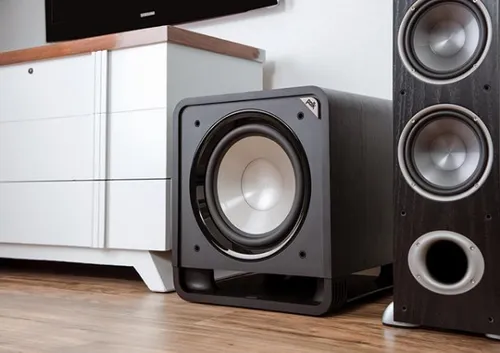
Watch a subwoofer on a test bench at full throw and the surround is the only part visibly working for a living. The cone looks solid, the spider is hidden, but that roll of rubber or foam is folding and unfolding further and faster than almost anyone designs for on a bookshelf tweeter. Get it wrong and the failure is not subtle — a split roll, a cone clattering against the frame, a driver that sounds fine in the shop and tears itself apart three weeks into a car audio install.
Surrounds for small, low-excursion drivers are mostly a solved problem. Surrounds for subwoofers pushing serious Xmax are a different conversation, and it starts with the roll, not the material.
Roll width and profile do the real work first
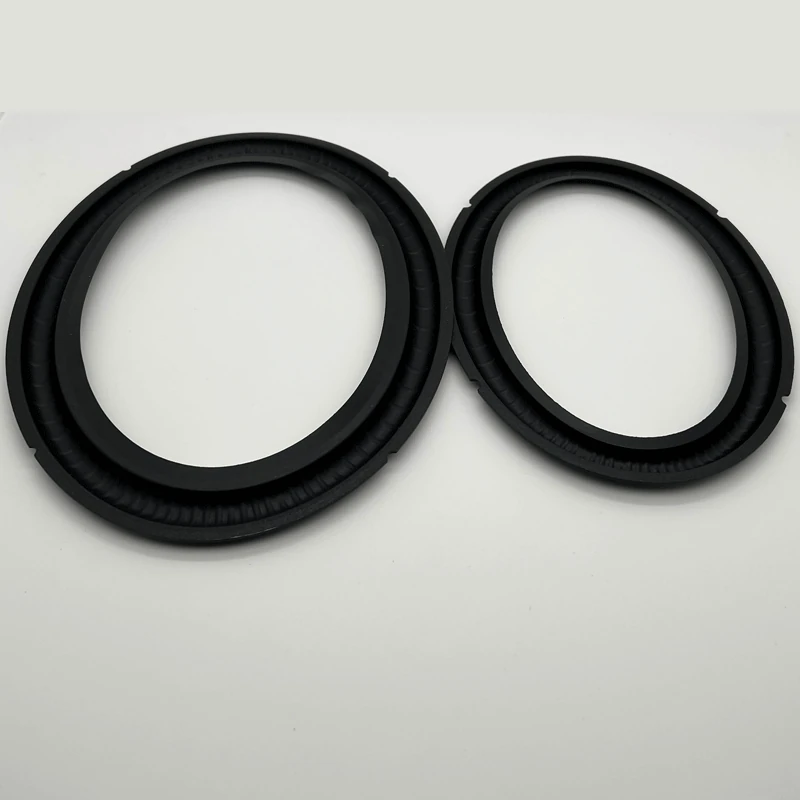
A surround's job is to seal the basket to the cone while letting the cone move axially without rocking or rubbing the voice coil against the pole piece. On a high-excursion driver that happens over a much longer stroke, so the roll itself — the half-round or M-shaped fold — has to be wider and deeper than on a modest 4" or 5" full-range cone. A narrow roll bottoms out mechanically before the amplifier runs out of power; a roll that is too soft lets the cone wobble off-axis under load, which is how you get coil rub blamed on "a bad batch of surrounds" when the surround did exactly what it was shaped to do.
Surround sourcing for subwoofers is a profile conversation before it is a material one: roll width, height and fold count all get tuned to the target Xmax, worked out per driver rather than picked off a shelf. Our range covers 2" to 18" surrounds in rubber and foam compounds, roll geometry built to the customer's driver rather than a fixed catalog shape.
Compliance vs control: the trade-off doesn't go away at scale
Everything true about compliance in a small driver is still true here, just with higher stakes. A softer surround is more compliant — it lets the cone move further for the same input, which is what a high-excursion woofer needs to move real air at low frequencies. A firmer surround controls the cone more tightly, damping edge resonance and keeping distortion down, at the cost of that free movement. We cover this trade-off in detail in rubber vs foam surrounds; the short version holds for big subs too — foam is lighter and more compliant on excursion-hungry designs, rubber trades some compliance for durability and control.
The margin for error just shrinks at high excursion. A surround slightly too stiff on a satellite speaker sounds a little tighter than intended. The same mismatch on a subwoofer near its mechanical limit can mean the cone never reaches the excursion the design assumes — or it reaches it and something downstream, spider, coil former, or the surround itself, takes damage repeatedly instead of occasionally.
Material choice: foam for excursion, rubber for the long haul
Foam remains the material of choice where maximum excursion and minimum moving mass matter most, which is why vintage-style and weight-sensitive designs still spec it. Its trade-off is service life: foam dries out and crumbles over years of thermal cycling, and a subwoofer surround failure is bigger and costlier than a tweeter surround failure. Rubber compounds close that durability gap, each with its own bias:
| Compound | Excursion behaviour | Durability trait | Typical fit |
|---|---|---|---|
| Foam | Highest compliance, lightest moving mass | Shorter service life, prone to rot | Vintage, weight-critical, max-Xmax subs |
| NBR | Moderate compliance | Cost-effective, general-purpose | Budget and mid-tier subwoofers |
| SBR | Moderate compliance | Economical | General-purpose, high-volume runs |
| EPDM | Moderate, firm control | Resists UV, ozone, humidity | Outdoor and marine subwoofers |
| Butyl (IIR) | Controlled, high damping | Low air leakage, long service life | Premium high-excursion woofers |
None of these is automatically "correct" for high excursion — the right call depends on how hard the driver is pushed, how often, and where, which is the conversation worth having before a mold is cut, on our custom service page.
Fatigue is the question a spec sheet doesn't answer
A surround can look right on paper — correct diameter, compound, Shore A hardness — and still fail early if the fold geometry or cure isn't consistent across a run. Validation goes beyond a single dimensional check: tensile testing and Shore A hardness confirm the compound is within spec batch to batch; salt-spray, UV-aging and constant temperature-humidity chambers confirm it survives the environment the driver will live in; two-dimensional optical measurement verifies roll profile and diameter to tolerance, not just an average across the batch.
One test is specific to acoustic components and rarely shows up at a general rubber molder: an F0 resonance-frequency tester, checking that surrounds land on a consistent resonant frequency part to part. On a subwoofer, where compliance and moving mass set the tuning of the whole enclosure, an F0 outlier is not cosmetic — it is a surround that will make one driver in a run sound different from the rest. Incoming, in-process and outgoing inspection catches that before it ships.
Sourcing for a high-excursion build
Getting a surround right for a demanding subwoofer means treating roll geometry, compliance and compound as one decision, validated with acoustic-specific testing a general rubber shop doesn't run. The full range of profiles and compounds is on our components page, and our team can walk through Xmax, roll width and compound together for your driver.
FAQ
What roll width does a high-excursion subwoofer surround need?
Wider and deeper than a standard full-range surround, sized to the driver's target Xmax so the cone reaches full stroke without bottoming out mechanically. Roll width is tuned per driver, not taken from a fixed catalog shape.
Is foam or rubber better for a high-excursion subwoofer?
Foam is lighter and more compliant, which is why it still shows up on excursion-hungry designs, but it has a shorter service life. Rubber — especially butyl for damping or EPDM for weather resistance — trades some compliance for a surround that survives years of hard cycling.
Why does resonance testing matter for subwoofer surrounds specifically?
A subwoofer's tuning depends on consistent compliance and moving mass across every unit in a run. An F0 resonance-frequency tester checks surrounds land on the same resonant frequency part to part, catching outliers that would otherwise make individual drivers sound different from the rest of the batch.
Can a surround cause voice coil failure on a high-excursion driver?
Yes, indirectly — a surround that is too soft or has the wrong roll profile can let the cone move off-axis under load, causing the coil to rub the pole piece. That usually gets diagnosed as a coil problem when the root cause is surround geometry not matching the driver's excursion.